How Weather Affects Greyhound Racing Performance
Best Greyhound Betting Sites – Bet on Greyhounds in 2026
Loading...
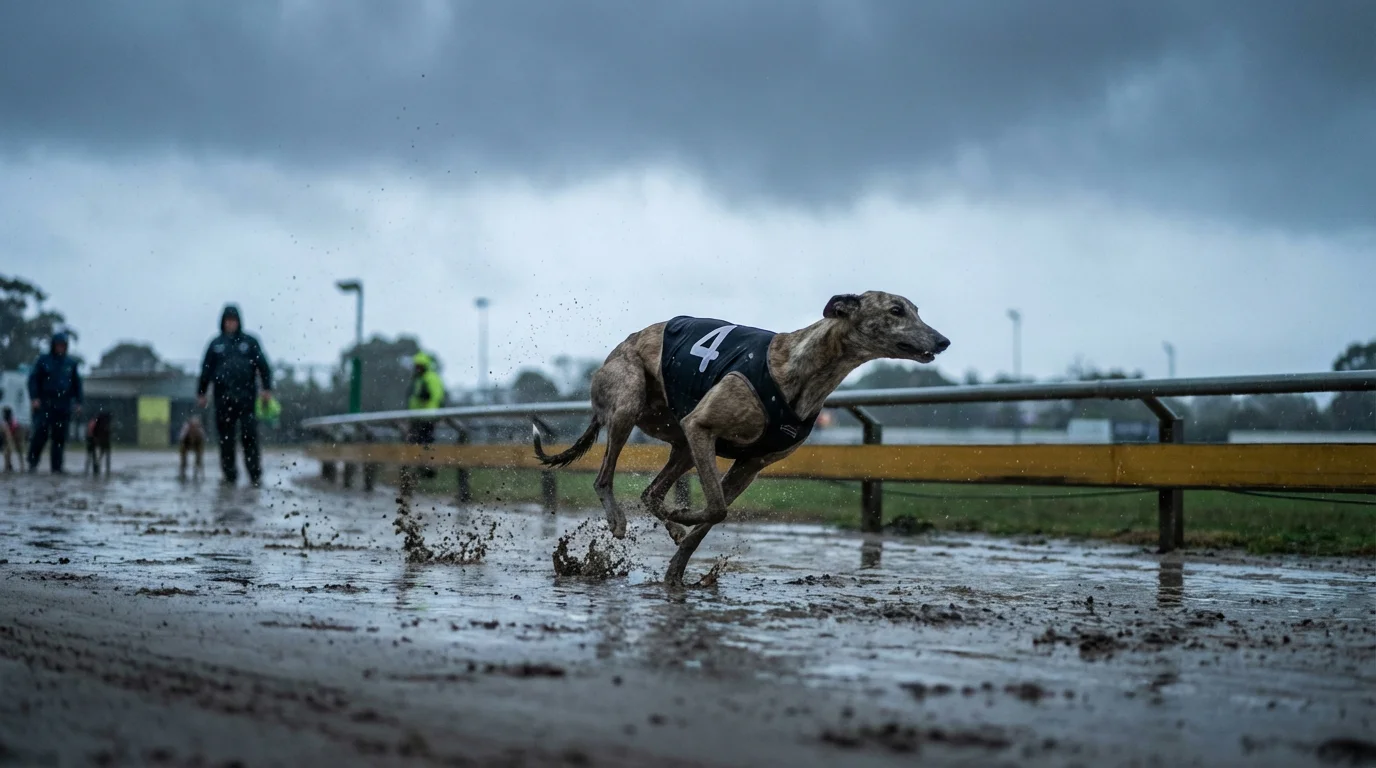
The Weather Is Running Too
Rain, wind, and temperature do not just change the atmosphere at a greyhound meeting — they change the racing surface, the going, the sectional times, and the relative advantage of different running styles. A dog that dominates on a dry, fast track may struggle on a waterlogged surface that saps its early pace. A closer that lacks the speed to compete on firm going may find the conditions turning in its favour when the heavens open.
Most punters check the weather as an afterthought, if at all. The sharper ones treat it as a variable that sits alongside trap draw, form, and grade context in their pre-race analysis. Weather effects on greyhound racing are measurable, predictable in direction if not in degree, and consistently underweighted by the betting market. This guide explains the mechanisms and shows how to adjust your selections when the conditions change.
Track Surface and Water: What Happens When It Rains
UK greyhound tracks use either sand-based surfaces or all-weather composites, and each responds to water differently. The critical variable is drainage — how quickly and evenly the track sheds rainwater, and how the residual moisture alters the running characteristics.
Sand-based tracks absorb water and become heavier as moisture accumulates. A track that runs fast and firm on a dry evening will run measurably slower after persistent rain, with finishing times extending by several lengths across a standard distance. The effect is not uniform across the track surface. Lower-lying sections, drainage channels, and the inside running line — which receives more traffic and compacts differently — may hold water longer than the outside, creating an uneven surface that disadvantages inside runners and shifts the usual trap bias.
All-weather surfaces, including the type installed at Central Park following the 2023 track surface investment (Central Park Stadium), are designed to drain more consistently and maintain more stable running characteristics across weather conditions. The impact of rain on an all-weather track is still present but less dramatic than on traditional sand. Times may slow slightly, and the going description will reflect the change, but the surface variation between inside and outside lines is typically smaller.
Heavy, sustained rain creates the most significant impact. A meeting that starts dry and encounters a downpour mid-card will see finishing times lengthen progressively as the surface deteriorates. Punters who notice this trend early can adjust their selections for the later races — favouring dogs with proven form on heavy going, dogs that race wide and avoid the churned inside line, and dogs with stamina that allows them to cope with the slower surface.
Wind is the less discussed weather variable. A strong headwind on the home straight slows finishing times and favours dogs that lead into the final bend, because they face less wind resistance while the chasers behind must battle the gust to close the gap. A tailwind does the opposite — it flatters closers by reducing the effort needed to accelerate on the run-in. Cross-winds can push dogs off their running line on the bends, adding an element of randomness that form analysis cannot predict.
Going Descriptions: What They Mean
UK greyhound tracks declare a going description for each meeting, indicating the current state of the racing surface. The standard descriptions range from “fast” through “standard” to “slow” and “heavy,” though the exact terminology can vary between tracks and data providers.
Fast going means the track is dry and running at or above its standard time. Dogs clock quick finishing times, the surface is firm underfoot, and early-pace runners tend to benefit because the ground allows them to maintain their speed without the energy drain of a softer surface. Fast going favours front-runners and sprint specialists.
Standard going represents the baseline condition that the track’s standard times are calibrated against. This is the going against which speed ratings are most reliably compared, because the adjustments needed are minimal. Most meetings in the UK run on standard or near-standard going, making it the default condition for form assessment.
Slow going indicates a heavier surface, usually caused by rain. Times are extended, the ground gives more under the dogs’ paws, and the energy cost of maintaining speed increases. Slow going favours dogs with stamina, strong finishers, and dogs whose running style does not depend on explosive early pace. Front-runners on slow going tire more quickly and are more vulnerable to being caught in the final straight.
The going description should be checked before every meeting and factored into your form comparison. A dog whose impressive sectional time was recorded on fast going may not reproduce that figure on a slow surface. Comparing times across different going conditions without adjustment is one of the most common errors in casual form analysis.
Dog-Specific Weather Impact
Individual greyhounds respond to weather conditions differently, and identifying these preferences is a genuine edge that few punters exploit systematically.
Some dogs are demonstrably better on heavy going. Their form shows a pattern: strong performances on wet days, mediocre results on dry tracks. This is usually a function of running style and physical build. Heavier, more powerful dogs with a longer stride can handle soft ground more effectively than lighter, speedier types whose advantage depends on firm footing. A dog that lacks the explosive early pace to compete on fast going may find that wet conditions neutralise the speed advantage of its rivals, bringing stamina and strength to the fore.
Temperature effects are subtler but present. Very cold conditions can stiffen muscles and reduce peak speed, particularly in older dogs or those with previous injuries. Extremely hot conditions — rare in the UK but not unknown during summer evening meetings — can cause fatigue more quickly, especially over staying distances. Most UK greyhound racing takes place in moderate conditions where temperature has minimal impact, but meetings at the extremes of the calendar deserve a moment of thought about whether the conditions suit your selection.
Wind sensitivity is the hardest factor to assess because it varies not just between dogs but between tracks. A dog that races wide on a track with an exposed home straight will be more affected by a headwind than a dog that rails along the inside, where the stands may provide some shelter. There is no racecard data point for wind performance, so this assessment relies on watching races and noting which dogs cope well or poorly in breezy conditions.
Adjusting Your Selections for Conditions
The practical adjustment process starts with checking the weather forecast and the declared going before you study the racecard. If the going is significantly different from the conditions under which the dogs recorded their most recent form, your assessment needs to account for the gap.
On heavy or slow going, upgrade dogs with proven wet-track form or a running style that suits heavier conditions — closers, stayers, dogs with a strong finishing kick. Downgrade front-runners that depend on fast early speed, particularly those drawn on the inside where the surface may be heaviest. If a dog’s entire recent form was set on fast going and tonight’s meeting is running slow, treat those times with scepticism regardless of how impressive they look on paper.
On fast going after a spell of wet weather, the reverse applies. Dogs that have been competing on slow surfaces may produce improved times simply because the ground is now in their favour. A dog that finished fourth on slow going last week may be a significantly better proposition on a fast track tonight, and the market may not fully adjust for the going change.
Monitor the track during the meeting. If conditions deteriorate as the card progresses — common during autumn and winter evenings — the going for the last few races will be different from the first. Adjusting your selections mid-meeting based on how the track is riding is a habit that separates attentive punters from those who made all their selections in the morning and did not revisit them.
The Conditions Are Part of the Race
Weather is not noise to be filtered out of your analysis. It is a variable that changes the race — sometimes subtly, sometimes dramatically — and punters who incorporate it into their selection process hold an edge over those who treat every meeting as if it were run under identical conditions. Check the going, check the forecast, check your selections against the conditions, and adjust. The dogs run on whatever surface the weather provides. Your analysis should reflect the surface they are actually running on, not the one you wish they were.