What Is Trap Bias in Greyhound Racing?
Best Greyhound Betting Sites – Bet on Greyhounds in 2026
Loading...
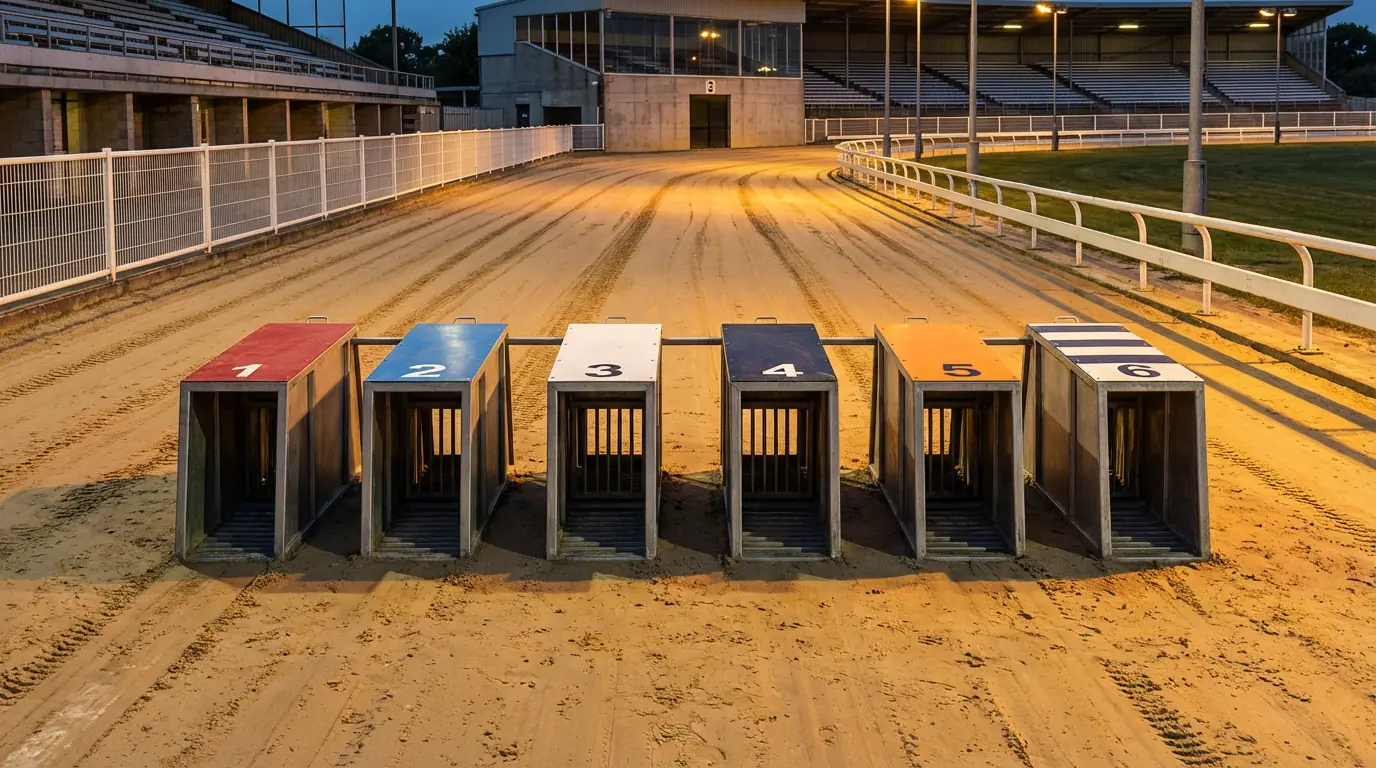
Trap Bias: The Hidden Variable
Trap bias is not luck — it is geometry. At every greyhound track in the UK, certain trap positions win more often than others over specific distances, and this imbalance is not random. It is a structural feature of the track itself, produced by the physical layout of the bends, the position of the hare rail, the distance from the traps to the first bend, and the width of the running surface.
Most punters know that trap draws matter. Fewer understand why they matter differently at different tracks and over different distances, or how to quantify the advantage that a favourable draw provides. Trap bias is one of the few genuinely predictive data points available in greyhound racing — a measurable, repeatable pattern that exists independently of the dogs in the race. It does not tell you who will win, but it tells you which starting positions have a structural advantage before the traps even open.
This guide explains where trap bias comes from, how to measure it, and how to integrate it into your selection process without overweighting a single variable.
Why Trap Bias Exists
Every track’s first bend creates winners and losers before the dogs hit top speed. The physics of six greyhounds breaking from traps, accelerating over a short straight, and then funnelling into a bend is where the vast majority of race incidents occur and where trap position exerts its strongest influence.
The critical factor is the distance from the traps to the first bend. On tracks with a short run-up, dogs in inside traps (1 and 2) have a natural advantage because they are closer to the rail and can establish position on the bend without needing to cover extra ground. Dogs in outside traps (5 and 6) must either show blistering early pace to cross the field before the bend or accept being forced wide, which adds distance and costs time. On tracks with a longer run-up, the inside advantage diminishes because all six dogs have time to find their running positions before the bend arrives.
Bend radius matters equally. Tight bends amplify inside bias because the difference in distance covered between the inside and outside running lines is greater on a sharp turn than a sweeping one. A dog running wide on a tight first bend might cover two or three metres more than a dog hugging the rail — and in a sport decided by lengths, that margin is significant. Tracks with wider, more gradual bends tend to produce more even trap statistics because the penalty for running wide is smaller.
The hare rail position adds another layer. Most UK tracks use an outside hare (running along the outer perimeter of the track at ground level), which naturally draws dogs toward the middle and wider running lines. At some tracks, this pulling effect benefits certain traps disproportionately depending on the bend geometry and run-up distance. The surface type, camber, and drainage patterns also play subtle roles — sand tracks that become heavier on the inside after rain, for instance, can temporarily shift bias toward the outside.
None of these factors operate in isolation. The trap bias at any given track and distance is the cumulative product of run-up length, bend geometry, hare position, surface characteristics, and the prevailing racing styles of dogs in the local grading system. This is why bias patterns differ so markedly between tracks, and why data from one track cannot be assumed to apply at another.
How to Measure Trap Bias
Small samples lie. You need 500 or more races per distance to trust the numbers. This is the first and most important rule of trap bias measurement, and it eliminates most of the casual trap statistics you see quoted on forums and social media.
The basic measurement is simple: calculate the win percentage for each trap position (1 through 6) at a specific distance over a defined period. In a perfectly unbiased race, each trap would win approximately 16.7 percent of the time (one in six). Deviations from that baseline indicate bias. If Trap 1 wins 22 percent of races over 450 metres at a particular track while Trap 6 wins only 11 percent, the inside bias at that distance is statistically meaningful — provided the sample size is large enough.
The sample size caveat is critical. Over 50 races, random variation alone can produce apparent biases that do not reflect any structural reality. A trap that wins 25 percent of 50 races may simply have had a run of good dogs drawn there during that period. Over 500 races, the influence of individual dog quality washes out and the underlying structural bias emerges. Over 1,000 races, the figures become highly reliable.
Distance-specific analysis is essential. Trap bias at 277 metres (a sprint with a single bend) is often completely different from trap bias at 480 metres (a middle-distance race with multiple bends) at the same track. Always measure bias by distance, not by track as a whole. A single headline figure for “trap bias at Central Park” is meaningless because the bias changes with the race configuration.
Seasonal variation also warrants attention. Tracks with sand surfaces can see bias shift between summer (drier, faster, more even) and winter (wetter, heavier, potentially favouring inside or outside depending on drainage). Checking bias figures for the current season rather than relying on annual averages adds a useful layer of precision. Several data providers, including Timeform and some bookmaker analytics tools, publish regularly updated trap statistics broken down by track, distance, and period.
Using Trap Bias in Selections
Trap bias is a tiebreaker, not a verdict. This distinction is what separates intelligent use of trap data from lazy shortcutting. Bias tells you that, all else being equal, a dog in Trap 1 at Romford over 400 metres has a structural advantage over a dog in Trap 6. It does not tell you that Trap 1 will win. If the dog in Trap 6 is two grades better than anything else in the field, bias is irrelevant — class overrides geometry.
The correct way to integrate bias into your selections is as a secondary filter applied after your primary form analysis. First, assess each dog on its individual merits: recent form, sectional times, running comments, grade context, and trainer form. If your analysis identifies two dogs that are closely matched — similar form, comparable speed figures, no clear edge between them — trap bias becomes the deciding factor. The dog with the more favourable draw gets the nod.
This tiebreaker function is where bias delivers its most consistent value. In competitive graded races where four or five dogs have reasonable claims, there are frequently two or three runners that your form analysis cannot meaningfully separate. Checking which of those dogs has the more advantageous trap position, relative to the known bias for that distance, gives you a rational basis for a decision that might otherwise be a coin flip.
Bias should also influence how you assess a dog’s previous form. A dog that won from Trap 1 at a track with a strong inside bias did not necessarily run a great race — it may have been flattered by the draw. Conversely, a dog that finished third from Trap 6 at the same track may have run better than the bare result suggests. Adjusting form figures for trap draw is an underused analytical technique that can reveal value the market has missed.
Where bias should not override your analysis is in cases of clear class difference. A Grade A1 dog drawn in an unfavourable trap against A4 opposition will almost certainly overcome the draw through sheer superiority. Bias operates at the margins — when the quality gap is small, the structural advantage of trap position can be decisive. When the quality gap is large, it is noise.
Trap Bias at Popular UK Tracks
Bias profiles vary significantly across UK tracks, and punters who bet on meetings at multiple venues need to adjust their expectations accordingly. Here are brief profiles of some of the most commonly bet tracks.
Central Park (Sittingbourne) runs a relatively even track following its 2023 renovation, which included a £500,000 investment in major track work and a shift to new standard distances of 277m, 491m, and 664m. The remodelled bends are wider and more symmetrical than at many UK venues, which reduces the inside advantage seen at tighter circuits. Over 491 metres, the bias is marginal — Traps 1 and 2 hold a slight edge, but the difference from the theoretical 16.7 percent baseline is small enough that form and class are the dominant factors. Over the longer 664-metre distance, the bias is even flatter, as the additional running gives dogs time to find their positions regardless of draw.
Romford is the textbook case of inside bias in UK greyhound racing. Over its principal 400-metre distance, Trap 1 historically wins at rates approaching 20 to 25 percent, while Trap 6 can dip below 10 percent in some sample periods. The track is tight, the first bend arrives quickly after a short run-up, and the inside rail is a significant advantage. Punters betting regularly at Romford who ignore this data are giving away edge on every race.
Crayford, before its closure in January 2025, presented an interesting counter-example. Over its shorter distances, the sharp bends created a moderate inside bias similar to Romford. But over the 380-metre trip, Trap 6 historically performed better than expected because the run to the first bend was long enough for outside dogs with early pace to establish position. This distance-dependent reversal illustrates why track-wide bias claims are unreliable — you must always check by distance.
Hove, with its longer circumference and sweeping bends, is among the fairest tracks in the UK. Trap statistics across all distances tend to sit close to the expected distribution, making form and class more important than draw at this venue. Sheffield (Owlerton) sits at the opposite end of the spectrum — a tight, sharp track where inside traps hold a consistent advantage over most distances.
Bias Is Data — Use It That Way
Bias sets the stage. Form writes the script. The punters who extract consistent value from trap bias data are those who treat it as one input among many — important, measurable, and structural, but never sufficient on its own.
The temptation with any quantifiable edge is to overweight it. When you discover that Trap 1 wins 22 percent of races at your regular track, the instinct is to back Trap 1 in every race and assume the maths will deliver profit over time. It will not, because the bookmakers also know the bias data. Prices on favourably drawn dogs already reflect the structural advantage. The edge from bias is not in blindly backing inside traps — it is in identifying situations where the market has not fully accounted for the draw, or where the interaction between bias and individual form creates a value gap.
Build trap bias into your pre-race routine. Before studying the form for any race, check the track’s bias profile for that distance. Note which traps are favoured and which are disadvantaged. Then, as you work through each dog’s form, factor the draw into your assessment — upgrading the chance of a well-drawn dog with decent form, and downgrading the chance of a poorly drawn dog whose form was achieved from a more favourable position.
Over time, this systematic integration of trap data sharpens your selections without distorting them. The dogs still have to run. But knowing which starting position gives them a structural head start — or a structural handicap — is the kind of quiet, repeatable advantage that compounds across hundreds of bets into genuine profit.