How Greyhound Forecast Betting Works: Full Guide
Best Greyhound Betting Sites – Bet on Greyhounds in 2026
Loading...
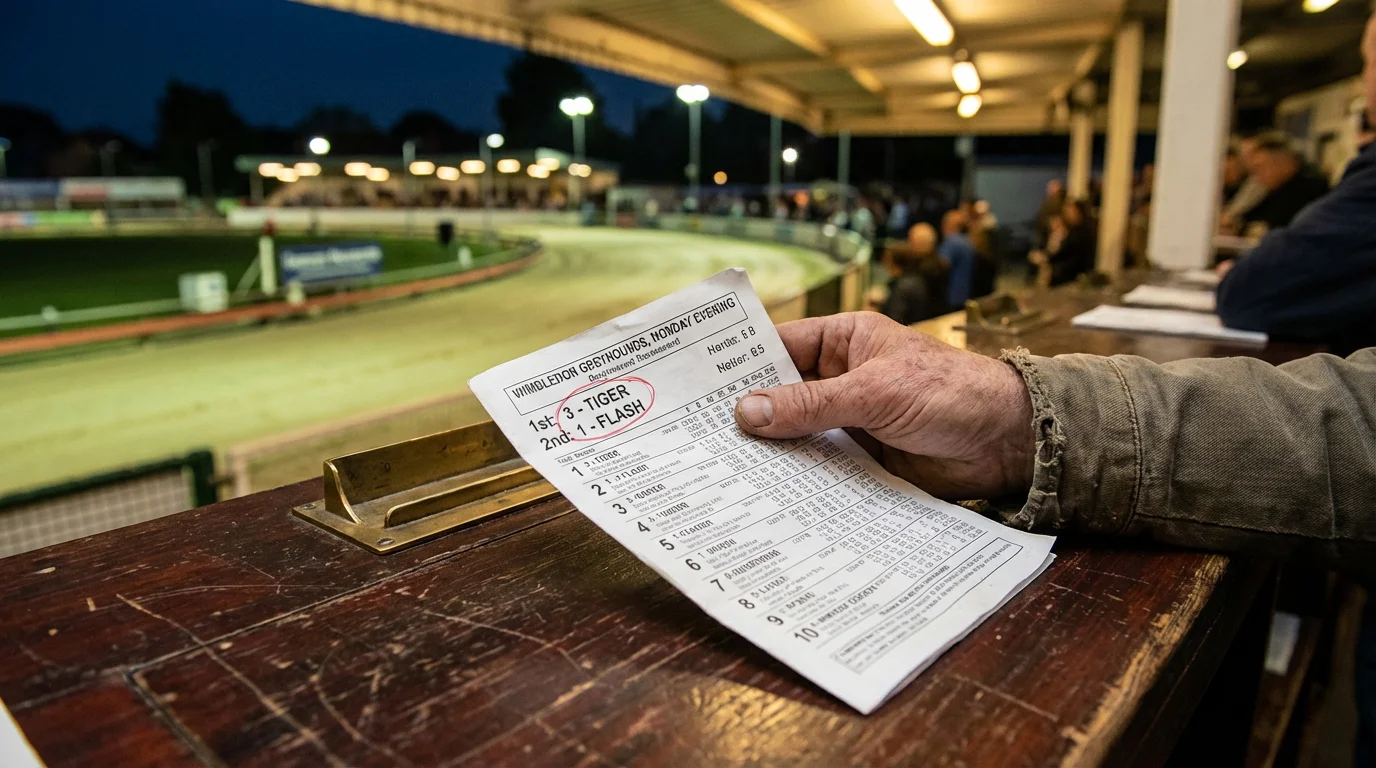
Forecasts Reward Precision, Not Luck
A win bet asks who finishes first. A forecast asks you to tell the full story — first and second, sometimes in exact order, sometimes not. It is the natural progression for any greyhound punter who has moved beyond backing the favourite and started reading form with genuine attention.
Forecast betting exists because predicting two finishing positions is significantly harder than predicting one, and the market rewards that difficulty accordingly. Dividends on forecast bets frequently dwarf the returns of a simple win bet on the same race, especially in competitive graded fields where four or five runners have a realistic chance. The catch, naturally, is that you need to be right twice rather than once. But for punters who study racecards seriously — form figures, trap draws, sectional times, running comments — forecast betting converts knowledge into returns that flat win betting simply cannot match.
This guide breaks down every variant of the forecast bet, explains when each makes sense, and lays out the situations where your racecard analysis justifies the extra complexity.
Straight Forecast: Exact 1-2
The straight forecast is the purest form of this bet type. You name the dog that will finish first and the dog that will finish second, in that exact order. One unit stake, one outcome. Get the order wrong — even if both your selections fill the top two places — and you lose.
Straight forecasts are settled by a computer-calculated dividend, not by fixed odds. The Tote (or the bookmaker’s computer straight forecast system) determines the payout based on the actual money wagered into the pool and the finishing order. This means the dividend is unpredictable at the time of placing the bet. You might back a 3/1 shot to beat a 5/2 shot and collect a dividend of 18.40 to a £1 stake, or you might collect 11.20 — it depends entirely on how other punters in the pool played the same race.
Here is a practical example. You study the racecard for a Central Park 450m A3 race and identify Trap 2 as the likely winner on recent form and Trap 5 as the most probable runner-up based on strong sectional times and a favourable wide draw. You place a £2 straight forecast: Trap 2 first, Trap 5 second. The race finishes exactly as predicted and the computer forecast dividend is declared at £22.70 to a £1 stake. Your return is £45.40.
Had Trap 5 won with Trap 2 second, you would have lost. The order is everything. That rigidity is what makes straight forecasts both demanding and rewarding. Name the first two home, in order, and the dividend does the rest.
Straight forecasts work best in races where you have a strong view on both positions — not just the winner but a clear reason to expect a particular dog to fill second place. If your analysis only gives you a confident first pick, you are better off with a win bet.
Reverse Forecast: Either Order
Reverse forecasts split the difference between confidence and caution. You select two dogs to finish first and second, but you do not specify the order. In practice, this is simply two straight forecasts combined into a single bet — one with Dog A first and Dog B second, the other with Dog B first and Dog A second. The cost is therefore two units.
The appeal is obvious. Many races feature two runners that look head and shoulders above the rest on form, but predicting which of them will lead the other home is a coin flip. Maybe both dogs are front-runners drawn on opposite sides of the track. Maybe one has a slightly quicker early pace but the other has a stronger finish over the distance. In these situations, the straight forecast becomes a gamble on a marginal call, whereas the reverse forecast lets you express your core opinion — these two dogs will fill the frame — without being punished for getting the order wrong.
The trade-off is straightforward: you pay double the stake. If the dividend for the winning permutation is £18, your net return on a £1 reverse forecast (costing £2) is £16. On a straight forecast, that same outcome would have returned £17 (£18 minus your £1 stake). The margin is small, but it adds up over volume. More importantly, the reverse forecast covers the permutation that would have been a losing bet on a straight forecast, which over a season of betting catches enough winners to justify the extra cost.
Use reverse forecasts when your form study clearly isolates two dogs from the field but gives you no convincing separation between them. If one dog is a clear top pick and the other is a speculative second choice, a straight forecast is the sharper bet.
Combination Forecast: Wider Net
Combination forecasts are insurance policies — and the premium adds up. The idea is simple: select three or more dogs and cover every possible first-and-second permutation between them. The complexity, and the cost, escalates quickly.
With three selections, you cover six permutations (3 x 2). Four selections generate 12. Five selections produce 20, and if you were reckless enough to include all six runners, you would be covering 30 permutations. At £1 per unit, a three-dog combination forecast costs £6. A four-dog version costs £12. These are not trivial stakes for a single race, and the dividend needs to justify the outlay.
The maths of combination forecasts only work when the race itself is genuinely open. A six-runner A4 graded race at Central Park where three dogs have comparable recent form, similar sectional times, and no obvious trap disadvantage is a textbook candidate. You rate all three to fill the first two places but cannot separate them. Covering the six permutations at £1 each means your total outlay is £6, so the winning dividend needs to clear that figure before you see profit. In competitive races between evenly matched runners, forecast dividends tend to sit in the £15 to £40 range, making a three-dog combination a reasonable play.
Where combination forecasts become dangerous is when punters stretch them beyond three selections as a substitute for proper analysis. Adding a fourth dog because you are not sure rather than because form genuinely supports it turns a structured bet into a scatter-gun approach. The cost doubles from £6 to £12, but the probability of landing a higher dividend does not increase proportionally. If you find yourself selecting four or five dogs in a combination forecast, ask yourself whether you have studied the racecard at all or simply hedged against your own uncertainty.
Keep combination forecasts tight. Three dogs maximum in most cases. If the race is so open that you need four, it might be a race to leave alone entirely.
When Forecast Bets Make Sense
Don’t forecast every race — forecast the right races. This is the single most important discipline in forecast betting, and it separates punters who profit from the bet type from those who bleed money into it.
The ideal forecast race has a clear structural feature: two dogs stand out from the field, but their win prices are too short to offer meaningful value on a single bet. A race where the form points to Trap 1 at 2/1 and Trap 4 at 5/2, with the remaining four runners at 6/1 or longer, is a classic forecast opportunity. Backing Trap 1 to win returns a modest profit. But a straight or reverse forecast combining Traps 1 and 4 can return three or four times that amount because the dividend factors in the difficulty of naming the exact finishing order.
Competitive graded races at middle distances — 450m and 480m at most UK tracks — tend to produce the best forecast conditions. These distances generate enough racing to allow genuine form comparison, the fields are usually well matched within the grade, and the results are less susceptible to the first-bend chaos that can scramble sprint races over 225m or 265m.
Another strong scenario is the race where a short-priced favourite looks a near-certainty for the win, but the battle for second place is wide open. A straight forecast anchored on the favourite with a longer-priced second selection can produce excellent value because the dividend is driven upward by the unpredictability of the runner-up position. If three or four dogs have a realistic claim on second place, the pool is spread across many permutations, and the winning dividend benefits from that fragmentation.
Conversely, avoid forecasts in races where the entire field is closely matched and form offers no meaningful separation between any of the runners. These races look appealing because the potential dividends are high, but the probability of naming the correct first two from six evenly matched dogs is painfully low. High dividends exist because the outcome is nearly random — and betting on near-random outcomes is not a strategy.
The Forecast Mindset
Forecast betting demands a different kind of analysis than win betting. When you back a dog to win, your entire focus is on one question: can this dog beat the other five? When you bet a forecast, you are answering two questions simultaneously — who wins, and who runs second — and the second question is often harder than the first.
The runner-up in a greyhound race is frequently the dog that ran well but encountered one piece of bad luck: a slight bump at the second bend, a fractionally slower break from the traps, or the misfortune of sitting behind a front-runner that held on by a neck. Identifying that dog in advance requires attention to running comments, trouble-in-running notes, and pace analysis that many casual punters skip entirely. This is where forecast betting rewards the diligent student of form.
If you can’t explain why your second dog beats the rest — not the winner, but specifically the remaining four — your forecast is a guess dressed up as analysis. The discipline is to only place forecast bets when you have genuine conviction in both selections. One strong opinion and one vague feeling is not enough. Two strong opinions, supported by form, trap draw, and race conditions, is the minimum standard.
Build forecast betting into your approach gradually. Start with reverse forecasts in the races where two dogs genuinely stand apart. Track your results over twenty or thirty bets before expanding into straight forecasts and combinations. The returns will tell you whether your form reading is sharp enough to justify the bet type — and if it is, forecasts will become the most profitable tool in your betting repertoire.