Greyhound Speed Ratings Explained for Bettors
Best Greyhound Betting Sites – Bet on Greyhounds in 2026
Loading...
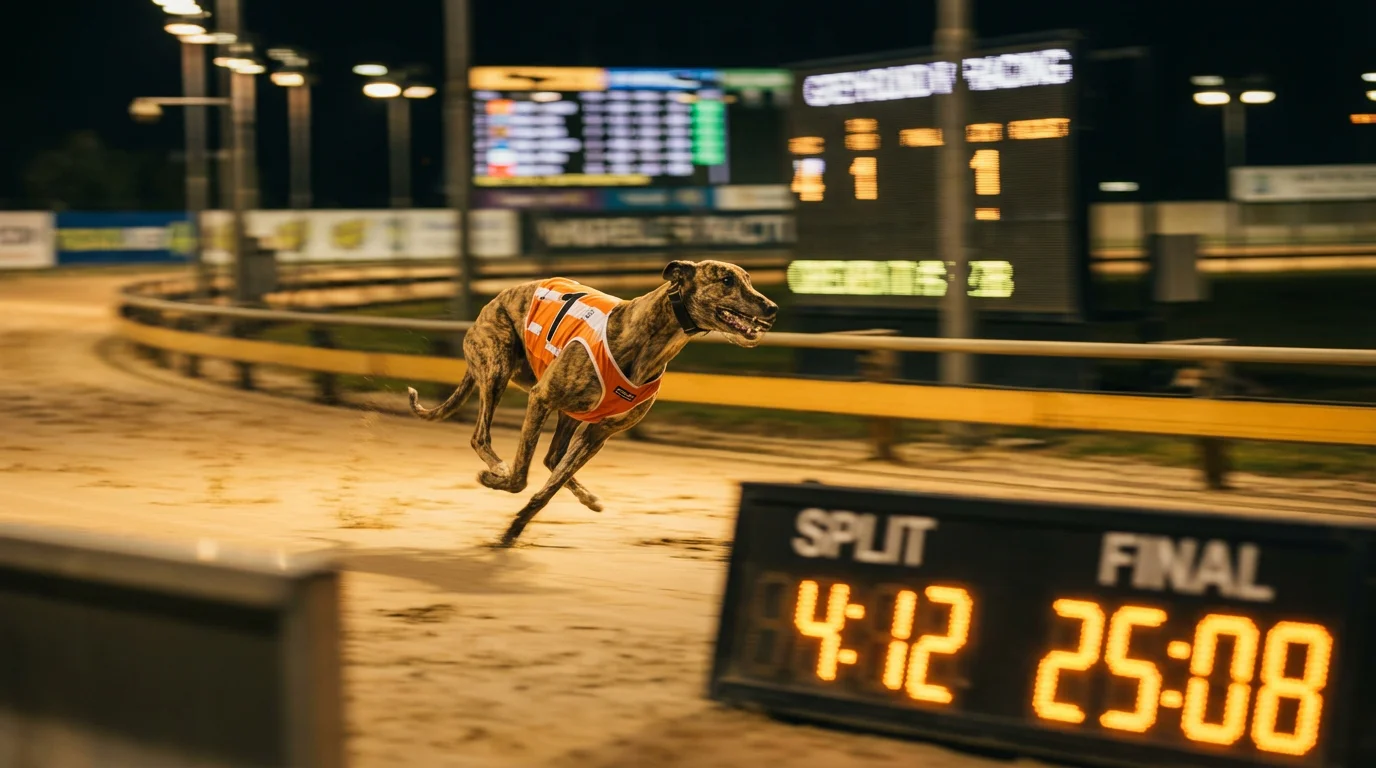
Speed Ratings: The Universal Ruler
Two identical times at two different tracks mean two very different things. A greyhound clocking 28.50 seconds over 480 metres at Hove is not the same animal as one running 28.50 at Romford, because the tracks are different lengths, the bends have different radii, the surfaces run at different speeds, and the grading standards are not equivalent. Raw finishing times, taken at face value, are one of the most misleading data points in greyhound racing.
Speed ratings exist to solve this problem. They take a dog’s raw time and adjust it for the specific conditions of the race — track standard, going, grade of opposition — to produce a single figure that can be compared across venues. A dog rated 85 at Central Park and a dog rated 85 at Nottingham have demonstrated equivalent ability, even if their actual finishing times were different. The rating is the common currency that makes cross-track comparison possible.
For punters, speed ratings are the closest thing to an objective measure of a greyhound’s ability. They are not perfect, and the sections below explain where they fall short. But as a starting point for any serious form assessment, there is nothing better.
How Speed Ratings Are Calculated
A speed rating strips the race of its context and shows you raw ability. The calculation process involves several layers of adjustment, each designed to remove a variable that would otherwise distort the comparison between dogs running under different conditions.
The first adjustment is for track standard. Every GBGB-licensed track has a standard time for each distance — a benchmark that represents the expected finishing time for a dog of average ability under normal conditions. This standard is recalculated periodically to reflect changes in track maintenance, surface composition, and hare speed. A dog’s actual time is measured against the track standard for that distance, and the difference — faster or slower — forms the raw basis of the rating.
The second adjustment accounts for the going. Just as horse racing tracks ride faster or slower depending on ground conditions, greyhound tracks run differently in wet versus dry weather, in cold versus warm temperatures, and in still versus windy conditions. On a day when the track is running two lengths slow — meaning the average time across all races is measurably slower than standard — a dog’s time is adjusted upward to reflect what it would have run under normal conditions. Without this correction, a dog running in heavy rain would appear slower than it actually is.
The third adjustment, used by more sophisticated rating providers like Timeform, factors in the quality of the opposition. A dog that runs 28.30 against A1 opposition has achieved something more impressive than one running 28.30 against B4 dogs, because the pace dynamics, crowding patterns, and early-speed pressures differ across grades. This class adjustment is the most subjective element of the calculation and the area where different rating providers diverge most significantly.
The final output is a number — typically on a scale where higher figures represent better performances. Timeform uses a scale broadly ranging from the 40s for very slow novice dogs up through the 90s and occasionally above 100 for the very best open-race greyhounds in the country. The absolute number matters less than the relative comparison: a dog rated 78 should be expected to beat a dog rated 72 at the same distance, all else being equal.
The word “calculated” is somewhat generous for some providers. At the top end, Timeform employs a team of analysts who watch races and make judgement calls about interference, trouble in running, and individual performances that pure time-based calculation would miss. At the free end, some bookmaker racecards offer simplified speed figures based purely on adjusted times without the class or subjective layers. Both have uses; neither is complete.
Using Speed Ratings to Find Value
The highest-rated dog does not always win — but it should always be priced accordingly. This is the core principle that turns speed ratings from a passive data point into an active betting tool. If the top-rated dog in a race is priced as though it were the third or fourth most likely winner, there is a gap between the market’s opinion and the evidence, and that gap is where value lives.
The most straightforward application is cross-track comparison. When a dog transfers from one track to another — perhaps moving from Romford to Central Park — its recent form figures and finishing times at Romford are difficult to interpret without context. Did it run fast because Romford is a quick track, or because it is a genuinely quick dog? Speed ratings answer that question. A dog rated 82 at Romford will be expected to perform at roughly the same level at Central Park, regardless of the difference in track configuration and standard times. If the betting market treats the transfer as an unknown and prices the dog at generous odds, the rating reveals the value.
Identifying improvers is another strength of speed ratings. A dog whose rating has risen from 68 to 72 to 76 across its last three runs is on an upward trajectory that the bare form figures might not make obvious — especially if those improvements have come at different tracks or over different distances. Rating trends are more reliable indicators of improvement than finishing positions alone, because they account for the changing quality of opposition that comes with grade promotions.
The flip side is equally useful. A dog whose rating has declined from 80 to 75 to 71 may still be winning races if it has been dropped in grade, but the ratings reveal that its actual performance level is falling. Backing a declining dog at a short price in a lower grade is a classic trap that speed ratings help you avoid.
One caution: beware of single-run ratings that look anomalous. A dog rated in the low 70s that suddenly posts an 84 in one race may have benefited from a clear run, a fast track, or weak opposition rather than genuine improvement. One data point is not a trend. Look for ratings that are sustained across two or three runs before adjusting your assessment of a dog’s ability level.
Where Speed Ratings Fall Short
Speed ratings do not account for the bump at the first bend. This is the single biggest limitation of any time-based performance measure in greyhound racing, and it matters more than casual users of ratings tend to appreciate.
Greyhound racing is a six-dog contact sport. Dogs bump, check, crowd, and interfere with each other on every bend, and the extent of that interference varies wildly from race to race. A dog that posts a rating of 78 in a clean, trouble-free run has demonstrated genuine ability. A dog that posts 78 after being bumped at the first bend and checked on the third has actually run a performance worth more than 78 — it lost time to interference and still clocked the same adjusted figure. Conversely, a dog that posts 78 in a race where it led from trap to line without a challenge may have been flattered by the absence of pressure.
The best rating providers attempt to account for interference through their subjective assessments, but the adjustments are imprecise. No mathematical model can perfectly quantify how many lengths a dog lost to a bump at the second bend, because the impact depends on the dog’s stride pattern, its ability to recover, and the specific dynamics of the incident. Ratings should always be read alongside running comments for this reason.
Going changes between the time of measurement and race day present another problem. A dog’s most recent rating was earned under specific track conditions. If tonight’s meeting is running significantly faster or slower than the day that rating was recorded, the figure becomes less reliable as a predictor. Ratings work best when track conditions are relatively stable; they become noisier during periods of unusual weather.
Finally, some greyhounds simply do not run to the clock. They run to the opposition. A dog that loafs when it leads but finds extra gears when challenged will post inconsistent speed ratings despite being a consistent performer. These dogs run as fast as they need to, not as fast as they can, and the ratings capture what happened rather than what was possible. Recognising these types requires watching races rather than reading numbers — a reminder that no single data source replaces genuine engagement with the sport.
Where to Find Reliable Speed Ratings
You do not need to calculate your own ratings — but you should understand how they are made, which is what the sections above covered. In practice, several providers publish greyhound speed ratings that you can use directly in your form analysis.
Timeform is the gold standard. Their greyhound ratings are produced by a dedicated team of analysts and incorporate time adjustments, going corrections, class weighting, and subjective assessments of interference. Timeform ratings are available through their website and are also integrated into some bookmaker racecards. Access to the full rating set requires a subscription, but the investment is modest relative to the edge the data provides.
The Racing Post publishes speed figures as part of its greyhound form data, available both online and in print. Their figures are less granular than Timeform’s but are widely used and freely accessible through most Racing Post digital subscriptions. For punters who already use the Racing Post for form, the speed figures are a natural addition to the analysis without extra cost.
Several bookmakers include simplified speed ratings or calculated times in their racecards. These tend to be basic adjusted times rather than full ratings, but they are free and readily available at the point of betting. They serve as a quick reference for same-track comparisons, though they lack the cross-track reliability of dedicated rating providers.
Ratings Are a Starting Point, Not the Finish Line
The clock measures speed. The punter measures everything else. Speed ratings are the single most useful tool for assessing a greyhound’s underlying ability, but they are not the whole picture. A rating tells you how fast a dog has run after adjustments. It does not tell you how it will handle tonight’s trap draw, whether it will cope with a front-runner breaking sharply from an adjacent trap, or whether its trainer has it peaking for this specific race.
The best use of speed ratings is as the foundation layer of your analysis. Start with the ratings to identify which dogs have demonstrated the highest level of ability. Then layer on the variables that ratings cannot capture: trap draw relative to running style, recent form trend and trajectory, going conditions on the day, and the pace dynamics likely to unfold from the specific combination of runners in the race. A dog with the best rating is always worth serious consideration, but it is not an automatic selection.
Think of ratings as a filter. They narrow the field from six unknowns to two or three serious contenders. What you do with that shortlist — how you weigh the non-speed factors, how you assess the price relative to the probability — is where the real betting skill lies. The ratings do the heavy lifting. The punter does the thinking.