Greyhound Racecard Symbols & Abbreviations
Best Greyhound Betting Sites – Bet on Greyhounds in 2026
Loading...
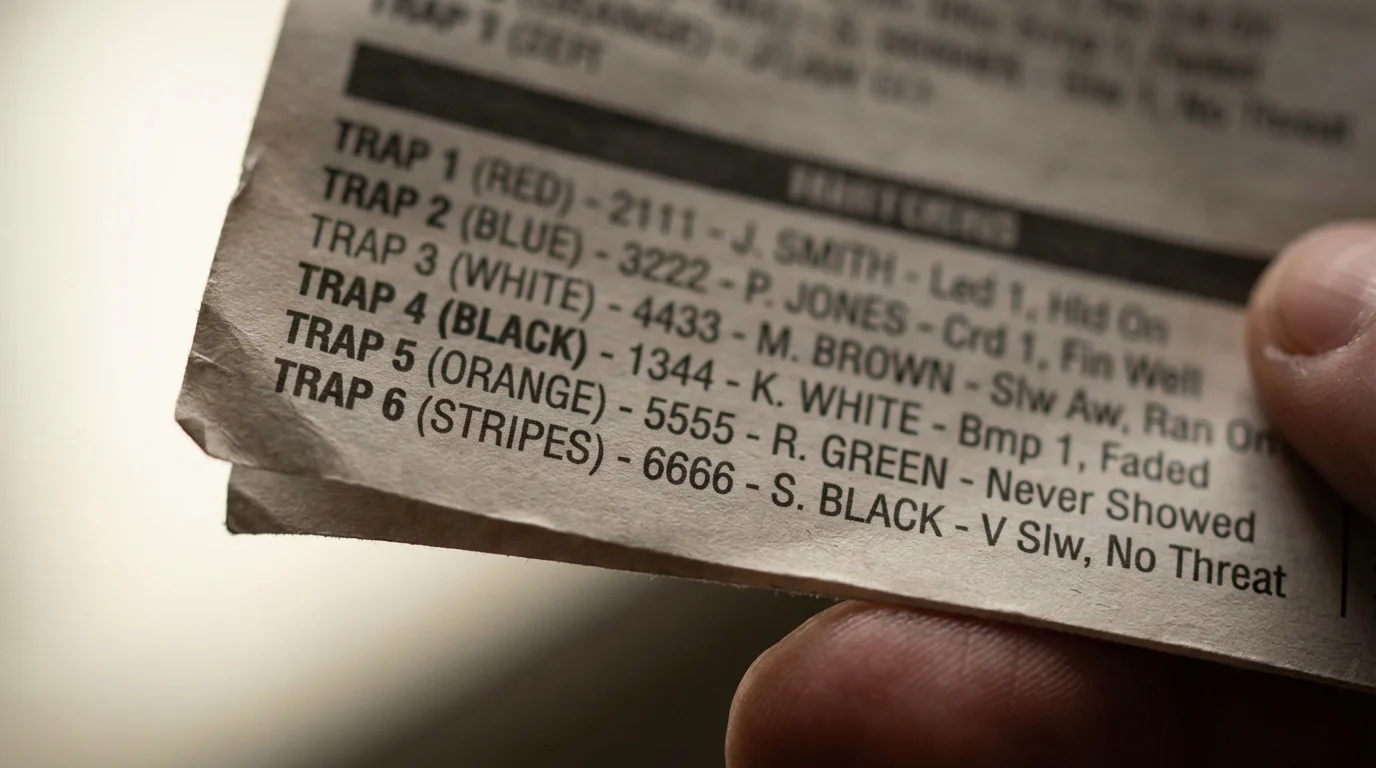
The Shorthand of the Dogs
Open a greyhound racecard and it reads like code — until you know the key. Every racecard is densely packed with abbreviations, symbols, and shorthand notations that compress a dog’s entire racing profile into a few lines of text. For experienced punters, this compression is efficient: a glance at “SAw, Bmp1, Ck3, Fin5” tells a complete story. For beginners, the same string is impenetrable.
This guide is the decoder ring. It covers every standard abbreviation and symbol you will encounter on a UK greyhound racecard, organised by category and explained in terms of what each one means for your form assessment and betting decisions. Bookmark it, print it, refer to it until the shorthand becomes second nature.
Running Comment Abbreviations
SAw (slow away) tells you half the race story in two characters. Running comments are the most analytically valuable part of the racecard for serious form students, because they describe what actually happened during the race rather than just the finishing order. Here is a comprehensive breakdown of the abbreviations you will see most frequently.
Led means the dog led the race from the traps. This is significant because a dog that leads and wins has controlled the race, while a dog that leads and fades may lack stamina or have been flattered by a clear early run. EP (early pace) indicates the dog showed speed in the opening stages without necessarily leading — it was prominent but not in front. These two comments together distinguish between dogs that dominate from the off and those that simply start well. A comprehensive guide to reading these abbreviations is available from Timeform’s racecard guide.
SAw (slow away) is one of the most important comments for form assessment. A dog that was slow from the traps was immediately at a disadvantage, losing lengths at the start and needing to make up ground against dogs that broke cleanly. A poor finishing position after a slow away should be treated more leniently than the same position after a clean break. If a dog is consistently slow away, it may have a trapping issue — a structural problem rather than a one-off, which should factor into your assessment of its likely start in the next race.
Bmp (bumped) and Ck (checked) describe interference. Bmp means the dog made physical contact with another runner, while Ck means it was forced to check its stride — slow down — to avoid contact or recover from it. Both comments are followed by a number indicating where in the race the incident occurred: Bmp1 means bumped at the first bend, Ck3 means checked at the third bend. The location matters because interference at the first bend typically has a greater impact on the final result than interference later in the race, when positions are more established.
CrdRun (crowded on the run) indicates the dog was squeezed for room during the running, usually on a bend. Wide means the dog raced on the outside of the track, covering extra ground. Mid means it ran in the middle of the pack. Rls (railed) means it ran along the inside rail. These positional comments tell you about the dog’s running style and how it interacted with the track geometry. A dog described as Wide in consecutive runs may be a natural wide runner, which has implications for trap draw analysis.
Fin (finished) followed by a descriptor indicates how the dog finished the race: FinWell means it was finishing strongly, suggesting it might have won over a longer distance. FinTired means it was fading, suggesting the distance may be at the limit of its stamina. Other closing comments include RnOn (ran on, kept going) and Chl (challenged, making a late bid for position).
Additional comments you will encounter include DispLd (disputed the lead — raced head-to-head with another dog for the front), HldOn (held on — led but was being caught at the finish), and BlkRun (baulked on the run — had its path blocked by another runner). Each provides a specific piece of the puzzle that the bare finishing position cannot convey.
Form Figures and Notation
A dash in form figures is not absence — it is a layoff that matters. The string of numbers that appears on every racecard represents the dog’s recent finishing positions, and the notation system includes several conventions that go beyond simple digits.
Numbers 1 through 6 represent finishing positions in the dog’s most recent races, read left to right with the oldest run first and the most recent on the right. A form line of 231456 means the dog finished second, third, first, fourth, fifth, and sixth in its last six outings. The trend is downward, which is immediately apparent from the sequence.
A dash (-) in the sequence indicates a break in racing. This could mean a layoff of several weeks due to injury, a deliberate rest, a kennel transfer, or a period in season (for bitches). The dash is a flag that the continuity of form has been interrupted, and the runs before the dash should be treated with less weight than the runs after it. A form line of 112-456 tells you that whatever was working three runs ago is no longer working now.
Some racecards use letter prefixes to indicate the track at which a run took place. This is particularly useful when a dog has raced at multiple venues: C denotes Central Park, R might denote Romford, H might denote Hove, and so on. The exact letter codes vary between form providers but are usually explained in the racecard key. Track prefixes help you identify whether a dog’s form was earned at the venue it is racing at tonight or elsewhere.
The letter “m” following a finishing position sometimes indicates a middle-distance race, while “s” might indicate a sprint. A zero (0) in the form line represents a finishing position worse than sixth — typically used in races that had reserve runners or larger fields during competitions. An “F” indicates a fall, which is rare in flat racing but occurs occasionally in hurdles events.
Other Racecard Data Points
Weight is listed in kilos — and a 0.5kg change between runs can signal something. Beyond form figures and running comments, the racecard contains several additional data points that experienced punters use to refine their assessments.
Weight is displayed in kilograms and represents the dog’s weight at its most recent race. Greyhounds typically race between 25kg and 38kg depending on sex and build. What matters for betting purposes is not the absolute weight but the change from run to run. A weight loss of 0.5kg or more between races can indicate a dog that is being prepared for a specific target — trained hard and leaned up for peak performance. A weight gain of similar magnitude might indicate a dog that has been rested and has not been working as intensively. Significant weight changes, particularly losses exceeding 1kg, can also signal health issues and should prompt caution.
Age is listed in years and months. Greyhounds typically race from around 18 months to four or five years of age, with peak performance generally occurring between two and three-and-a-half years. Dogs at the younger end of the range may still be improving, while those approaching retirement age are more likely to be declining. Age is a slow-moving variable — it matters over months and years rather than race to race — but it provides context for form trends.
The season indicator is relevant for bitches (female greyhounds). A bitch in season is withdrawn from racing for a period, and her return to racing after a season can be marked by unpredictable performances. Some racecards indicate the date of the most recent season, allowing you to assess how long ago the interruption occurred. Bitches returning within a few weeks of a season are statistically less reliable than those who have had time to settle back into a racing routine.
Reserve status is indicated by an “R” on the racecard. A reserve runner is a standby dog that joins the field only if one of the six main runners is withdrawn. Reserves are often lower in the grading than the original entrants, and their inclusion can change the competitive dynamics of a race. If a reserve replaces a strong contender, the remaining main runners benefit; if a strong reserve replaces a weak withdrawal, the race becomes tougher.
Trainer information appears on every racecard and is worth monitoring for two reasons. First, certain trainers have significantly better strike rates at specific tracks, reflecting their familiarity with the venue and their ability to prepare dogs for its particular characteristics. Second, a trainer with several dogs in form suggests a kennel that is operating well — feeding, training, and managing its charges effectively — while a trainer on a long losing run may indicate systemic issues rather than individual bad luck.
Quick Reference Table
Print this. Stick it next to your screen. The following is an alphabetical reference of the most common UK greyhound racecard abbreviations, designed for quick lookup during live analysis.
BCrd — baulked and crowded. Bmp — bumped. BmpRnIn — bumped on the run-in. Ck — checked. CIr — clear run, no interference. CrdRun — crowded on the run. DispLd — disputed lead. EP — early pace, showed speed. EvCh — every chance, had the opportunity to win. F — fell. Fin — finished (followed by descriptor). FnlStr — final straight. HldOn — held on. Led — led the race. Mid — ran middle. MidRnIn — middle on the run-in. QAw — quick away from traps. Rls — railed, ran along the inside. RnOn — ran on, kept going. SAw — slow away from traps. SIRnUp — slight run-up. StbStr — stumbled on the straight. VSAw — very slow away. W — wide. WRunIn — wide on the run-in.
For form figures: digits 1-6 indicate finishing position. A dash indicates a break in racing. Letter prefixes indicate the track. “m” indicates a middle-distance race. “0” indicates a finishing position beyond sixth. “F” indicates a fall in hurdles.
For racecard data: weight in kilograms. Age in years and months. “R” denotes reserve runner. “S” or a date may indicate season information for bitches. Trap colours: 1-Red, 2-Blue, 3-White, 4-Black, 5-Orange, 6-Black & White Stripes.
Learn the Code, Read the Race
Once you read the shorthand without thinking, you are ready for the long game. Mastering racecard abbreviations is not an academic exercise — it is a practical skill that directly improves your betting speed and accuracy. The faster you can decode a racecard, the more races you can analyse in the limited time between card publication and the first race. The more accurately you read the comments, the better your form assessments become.
The learning curve is steep at the start and flattens quickly. After two or three meetings of deliberately checking each abbreviation against this guide, you will have memorised the twenty or so most common terms. After ten meetings, you will read running comments as fluently as plain English. After fifty, you will spot the meaningful details — the Bmp1 that wrecked a promising run, the SAw that explains a poor finish, the FinWell that hints at a dog ready to win next time — in seconds rather than minutes.
The racecard packs more actionable information per square centimetre than any other document a greyhound bettor encounters. Learning to read it efficiently is not a prerequisite for betting, but it is a prerequisite for betting well.