How Greyhound Racing Odds Are Calculated
Best Greyhound Betting Sites – Bet on Greyhounds in 2026
Loading...
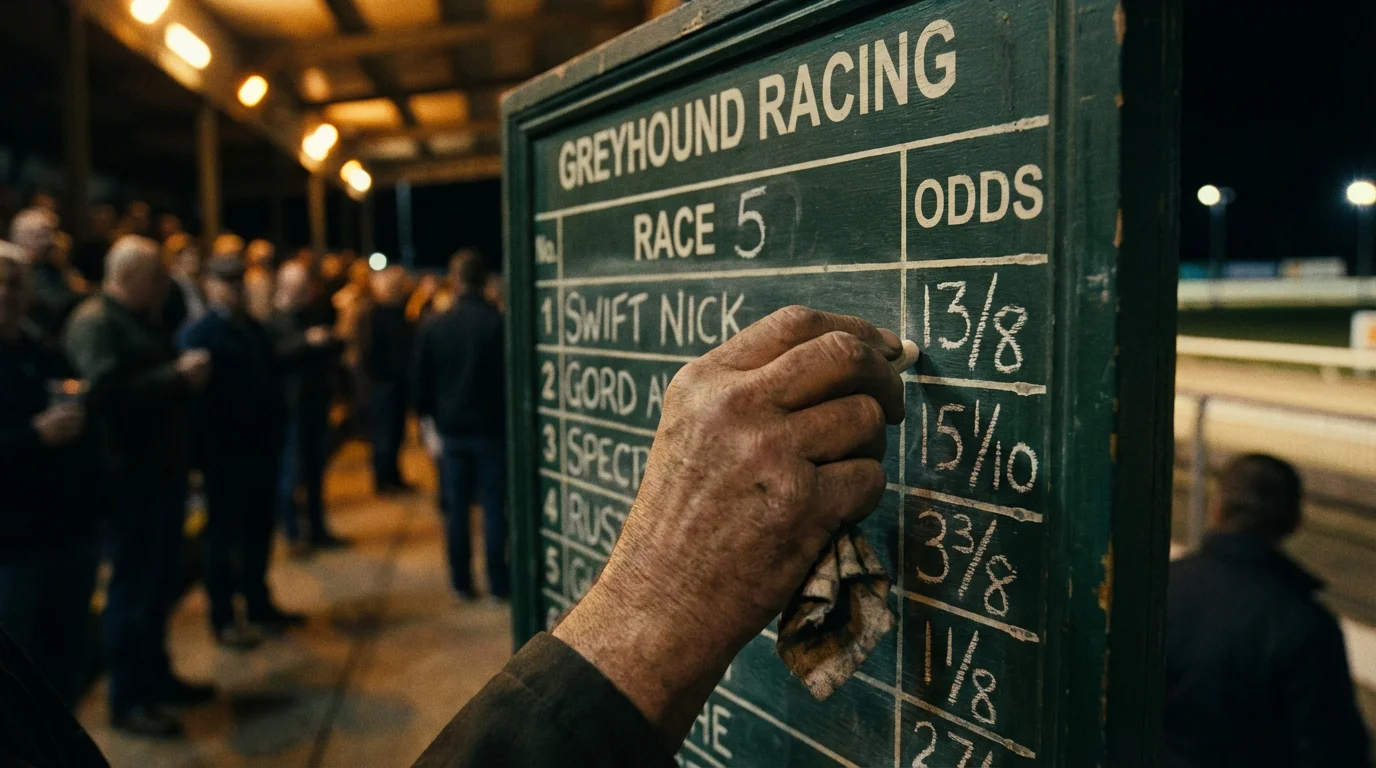
Odds Are Opinions With Money Behind Them
Greyhound odds are not mathematical truths. They are commercial products — prices set by bookmakers to attract balanced action across all six runners while building in a margin that guarantees the house a profit regardless of the result. Understanding how those prices are formed, where the margin sits, and when the market gets it wrong is the foundation of any serious betting approach.
Most punters accept the price on screen without questioning how it arrived there. That passivity is expensive over time. The price you see is the end product of a process involving form assessment, market supply and demand, bookmaker risk management, and competitive positioning between operators. Each step in that process introduces inefficiencies — and those inefficiencies are where value hides.
Bookmaker Margins: The Built-In Edge
Every greyhound betting market is overround. That term describes the mathematical reality that if you convert all six prices in a race to implied probabilities and add them together, the total exceeds 100 percent. The surplus is the bookmaker’s margin — the built-in house edge that ensures profitability across a large volume of bets regardless of individual race outcomes.
In a perfectly fair six-runner race with equal chances, each dog would be priced at 5/1, implying a 16.7 percent probability. Six runners at 16.7 percent sums to exactly 100 percent — a fair book with no margin. In practice, bookmakers price the same race at roughly 4/1 each, implying 20 percent per runner. Six runners at 20 percent sums to 120 percent. That extra 20 percentage points is the overround, and it means the bookmaker collects more in theoretical liability than they will ever pay out.
Real greyhound markets are not evenly priced, of course. A typical six-runner race might have a favourite at 6/4, a second favourite at 3/1, and the remaining four dogs at prices ranging from 5/1 to 12/1. But the principle holds: the implied probabilities of all six runners will always sum to more than 100 percent. The degree of overround varies between bookmakers and between markets — some operators run tighter books than others, and competitive markets on well-covered evening meetings tend to have lower margins than thin morning cards with limited betting interest.
For the bettor, the overround is the cost of playing. You cannot eliminate it, but you can minimise it by shopping for the best available price across multiple bookmakers. A dog priced at 7/2 with one operator and 4/1 with another represents a meaningful difference in implied margin. Over hundreds of bets, consistently taking the better price is one of the simplest and most effective ways to improve your return on investment.
How Greyhound Markets Are Formed
Greyhound markets are built in two stages. The first is the initial pricing, where bookmaker traders assess the form of each runner and set opening prices. The second is the live market, where prices move in response to actual betting activity before the race.
Opening prices are typically published several hours before a meeting begins. A team of traders — or increasingly, an algorithm fed by form data — evaluates each dog’s recent results, sectional times, trap draw, grade context, trainer form, and any other available information. The output is a set of prices for each runner that reflects the bookmaker’s assessment of each dog’s winning probability, adjusted to include the overround margin.
Once the market opens, prices move. If heavy money arrives on a particular dog, its price shortens to limit the bookmaker’s liability on that outcome. If money flows away from a dog, its price drifts outward. These movements are visible to anyone monitoring the market, and they carry information. A significant shortening of price — a “steamer” — suggests that informed money is backing the selection. A significant drift suggests either that informed money has gone elsewhere or that a negative factor (veterinary report, kennel issue, track condition) has emerged.
In greyhound racing, market movements happen quickly. The window between market opening and the off is much shorter than in horse racing, and the volume of betting is typically lower. This means individual large bets can move the price more dramatically than they would in a deeper, more liquid market. A single punter placing a significant stake on a 5/1 shot can compress the price to 3/1 in minutes on a morning SIS card, which may or may not reflect genuine private information — it could just as easily be a casual punter with a strong opinion and a big wallet.
The practical lesson: monitor the market for your intended selections, but do not treat every price movement as a signal. In deep evening markets with heavy betting volume, movements are more likely to reflect genuine information. In thin morning markets, they can be noise.
Tote Pools vs Fixed Odds
UK greyhound bettors have two fundamentally different pricing mechanisms available: fixed-odds betting with bookmakers and Tote pool betting where the dividend is determined by the total amount wagered.
Fixed odds are the dominant format. You see a price, you take it, and your return is locked in at that moment regardless of what happens to the market afterward. The advantage is certainty — you know exactly what you stand to win before the traps open. The disadvantage is that the price includes the bookmaker’s margin, and once you accept it, you cannot benefit from any subsequent favourable price movement (unless Best Odds Guaranteed applies).
Tote pool betting works differently. All bets on a race are pooled together, the Tote operator deducts its commission (the takeout rate for greyhound pools is typically 34 percent at most tracks, higher than horse racing pools), and the remaining money is divided among the winning ticket holders. The dividend is not declared until after the race, because it depends on how much money was bet and how it was distributed across the runners. If you back the winner and few others did, the dividend can be substantial. If you back a heavily supported winner, the dividend may be lower than the equivalent fixed-odds price.
For standard win bets, fixed odds usually offer better value because the bookmaker’s margin on singles is typically lower than the Tote’s commission. For forecast and tricast bets, the comparison is less clear-cut — computer straight forecasts and tricasts offered by bookmakers use their own calculation method, and the dividends sometimes exceed the equivalent Tote pool return. Checking both is worthwhile for exotic bets, though in practice most bettors settle on one system and stick with it.
Identifying Value in the Odds
Value exists when the bookmaker’s price implies a lower probability of winning than your own assessment suggests. If you believe a dog has a 30 percent chance of winning and the bookmaker prices it at 4/1 — implying 20 percent — the price is too generous. You have found value, and backing it at those odds is a positive expected-value bet over the long term, regardless of whether it wins the individual race.
The difficulty, obviously, is in forming an accurate assessment of probability. No punter can calculate a dog’s true winning chance to the decimal point. But you do not need to. You need to be approximately right more often than you are wrong, and you need the value gap to be large enough to overcome the bookmaker’s margin.
Practical value identification starts with a simple exercise: before looking at the prices, study the racecard and rank the six runners in order of your expected finishing probability. Assign rough percentage chances to each. Then compare your rankings and percentages to the bookmaker’s prices. Where your assessment differs significantly from the market’s — where you rate a dog substantially higher than the odds imply — you have a potential value bet. Where your assessment agrees with the market, the price is fair and there is no edge to be had.
Over time, this process trains your judgement. You will find that you consistently identify value in certain types of races — perhaps competitive A-grade middle distances — and consistently fail to find it in others. That pattern tells you where to concentrate your betting and where to leave the market alone. The odds are not your enemy. They are a scoreboard that tells you when the market disagrees with your analysis — and sometimes, the market is wrong.
The Odds Reflect the Market, Not the Race
Greyhound odds are a mirror of collective opinion, distorted by commercial margin. They are not a prediction of the result, and they are not always accurate. The market underestimates some dogs and overestimates others on every single card, because the market is composed of humans — traders, algorithms, and punters — all working with incomplete information and personal biases.
Your role as a bettor is not to beat the dogs. It is to beat the market. That means understanding how the odds were formed, where the margin sits, and when your own analysis gives you a more accurate picture than the price on screen suggests. The odds are just the starting point of that conversation.