Each Way Betting on Greyhounds: How It Works
Best Greyhound Betting Sites – Bet on Greyhounds in 2026
Loading...
Two Bets in One: The Each Way Equation
Each way is not a hedge — it is a separate bet that happens to travel with the first. That distinction matters, because most punters treat each way betting as a safety net rather than a calculated position, and the result is a slow, invisible erosion of their betting bank.
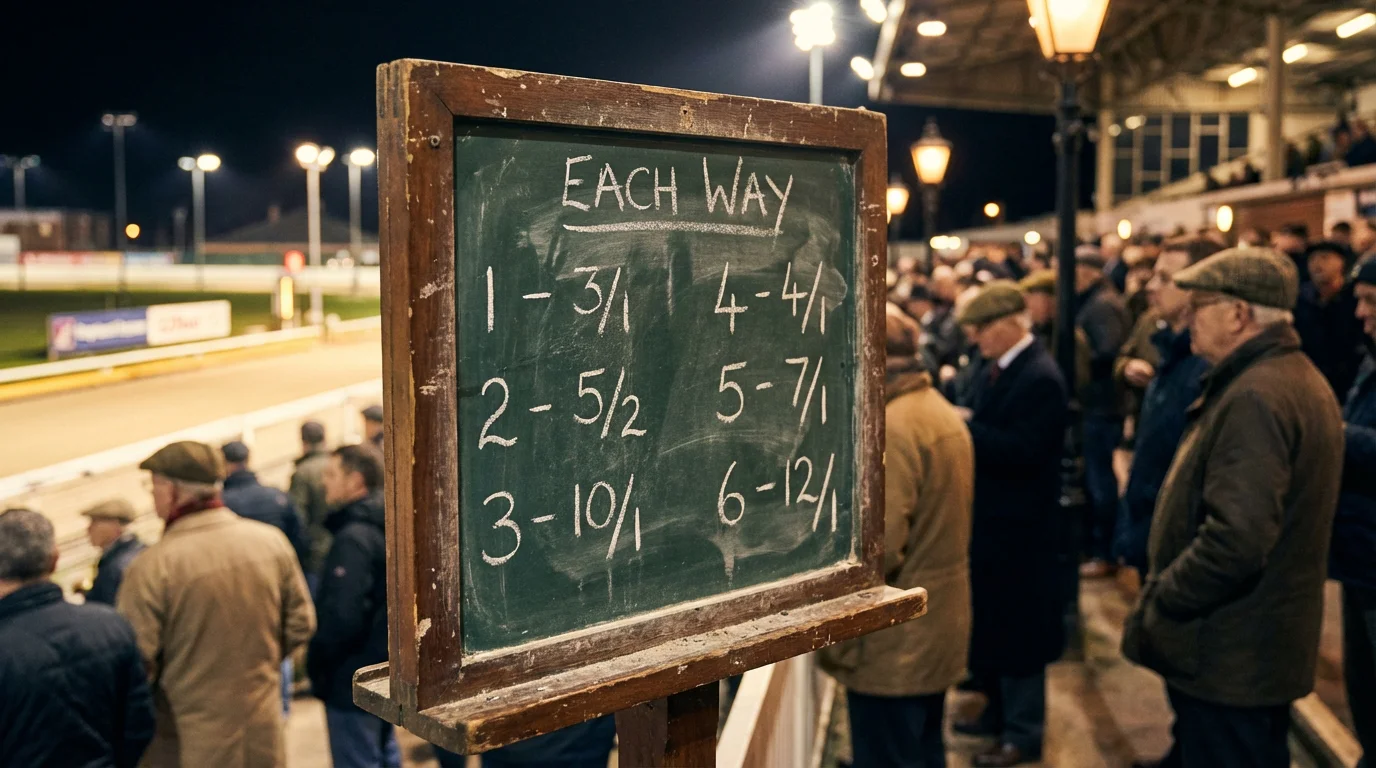
An each way bet consists of two equal stakes: one on your selection to win and one on your selection to place. In UK greyhound racing, “place” means finishing in the top two in a standard six-runner race. The win part pays at full odds if your dog wins. The place part pays at a fraction of those odds — typically one quarter — if your dog finishes first or second. Both parts pay if the dog wins; only the place part pays if it finishes second; neither pays if it finishes third or worse.
The crucial point that casual punters miss is that each way doubles your total stake. A “£5 each way” bet costs £10 — £5 on the win, £5 on the place. This means the returns need to justify twice the outlay, and in many situations, particularly at shorter prices, they do not.
How Each Way Bets Work in 6-Dog Races
UK greyhound racing operates with six-runner fields as standard, and the each way terms reflect that field size. Place terms are 1/4 odds for the first two places. These terms are consistent across licensed bookmakers for six-runner races and rarely vary.
A worked example makes the mechanics concrete. You back a dog at 7/2 each way for £5. Your total stake is £10 — £5 on the win at 7/2 and £5 on the place at 7/8 (one quarter of 7/2). If the dog wins, both bets pay: the win returns £22.50 (£5 x 3.5 + £5 stake) and the place returns £9.38 (£5 x 0.875 + £5 stake), giving a total return of £31.88 and a profit of £21.88. If the dog finishes second, only the place bet pays: you collect £9.38 from the place portion, meaning your profit is negative — you staked £10 and got back £9.38, a net loss of 62p.
That last figure is the one that should give every each way bettor pause. At 7/2, a place-only result barely covers your total stake. You need the dog to win to make any meaningful profit. The place portion at this price is almost decorative — it cushions the blow of a second-place finish but does not turn it into a winning bet.
The arithmetic shifts at longer prices. At 8/1 each way for £5 (total stake £10), a place-only result returns £15 (£5 x 2.0 + £5 stake), giving a profit of £5. At 12/1, the place return rises to £20 on a £10 total stake. The longer the price, the more the place element contributes to genuine profitability. This relationship between price and place return is the foundation of intelligent each way betting.
Understanding these numbers is not optional. Every each way bet you place should be preceded by a quick mental check: if this dog finishes second, do I actually make money, break even, or lose? If the answer is “lose,” you need a very strong reason to believe the dog will win outright — in which case, a win-only bet at full stake might be the better play.
When Each Way Adds Value
Each way value lives in the gap between a dog’s win price and its place probability. The ideal each way bet is on a dog whose chance of finishing in the top two is significantly higher than its chance of winning — and whose price is long enough for the place return to generate genuine profit.
Consider a dog priced at 6/1 in a competitive A3 race. Your form analysis suggests it has roughly a 25 percent chance of finishing in the top two but only about a 10 percent chance of winning. The win bet alone is marginal — 6/1 implies roughly 14 percent probability, so there is value in the win price, but the strike rate will be low. The place portion at 6/4 (one quarter of 6/1), however, is backed by a 25 percent place probability, making the place element a strong bet in its own right. In this scenario, each way is not a compromise; it is the correct expression of your analysis.
Dogs with strong place form but questionable winning ability are classic each way candidates. Look for runners that consistently finish second or third — the form figures might read something like 233242. These dogs clearly have the ability to compete at the grade but lack either the early pace or the finishing kick to win regularly. At prices of 5/1 or longer, each way betting on consistent placers can be steadily profitable because the place portion alone carries positive expected value.
Another scenario where each way shines is the wide-running dog drawn in an outside trap on a track that favours inside runners. This dog might struggle to win because the track geometry works against it, but its natural pace and racing style give it a strong chance of claiming second. Backing it each way captures that probability without requiring an unlikely win.
When to Stick with Win-Only
Each way on a 6/4 favourite is a donation to the bookmaker. This sounds harsh, but the numbers are unambiguous. At 6/4, the place odds are 3/8 (one quarter of 6/4). A £5 each way bet costs £10. If the dog finishes second, the place return is £6.88 — a net loss of £3.12 on the total stake. You are paying £10 for the privilege of losing £3.12 when your selection finishes in the top two. The only profitable outcome is a win, which begs the question: why not just back it win-only at £10 and collect the full return?
The threshold below which each way becomes wasteful sits at around 3/1. At 3/1, a place-only result at 3/4 returns £8.75 on a £10 total stake — still a loss. At 7/2, you begin to approach breakeven on a place-only result. Below 7/2, each way is mathematically inferior to a win-only bet in almost all circumstances.
Short-priced favourites should always be backed win-only. If you believe a 4/6 favourite will win, back it at full stake on the nose. The place return at 1/6 is trivial and the total outlay doubles for no strategic gain. The same logic applies to any dog you rate as a strong winning chance — if your analysis says it wins, back the win. Each way dilutes your return on the bets where your conviction is strongest.
There is also a psychological trap in routine each way betting. Punters who default to each way on every selection tell themselves they are “protecting” their bets. In reality, they are systematically overpaying for insurance that rarely delivers a meaningful return. The place portion feels like a safety net, but over dozens of bets, the extra stake consumed by the place element drags overall ROI downward.
Each Way in Multiples: Lucky 15s and Patents
A Lucky 15 is 30 bets — and that is before you have factored in the mental maths. Each way multiples combine the compounding nature of accumulators with the dual-stake structure of each way betting, and the results can be both exhilarating and financially complex.
A Patent covers three selections across seven bets: three singles, three doubles, and one treble. Each way, that becomes 14 bets. A Lucky 15 covers four selections across 15 bets (four singles, six doubles, four trebles, one fourfold), which doubles to 30 bets each way. At £1 per unit, a Lucky 15 each way costs £30. The advantage of these named multiples is that individual winners among your selections return money through the singles even if the accumulator legs fail. The disadvantage is the substantial outlay.
Each way Patents work well when you have identified three dogs at decent prices (5/1 or longer) across separate races, each with strong place claims. If all three place without winning, the three each way singles all return a small profit on the place portion, and the each way doubles and treble on the place results can produce a surprising cumulative return. A Patent where all three selections place at 6/1, 8/1, and 5/1 returns noticeably more than the three individual each way singles combined, because the place doubles and treble compound the place odds.
Lucky 15s are more aggressive. With four selections, the cost is high but the upside if two or more selections win at decent prices is substantial. Many bookmakers also offer consolation bonuses on Lucky 15s — double odds for a single winner, or a percentage bonus if all four selections win — which can add meaningful value.
The danger with each way multiples is losing track of the total stake. Always calculate the full cost before placing the bet. A “£1 Lucky 15 each way” sounds modest until you remember it costs £30. Scale accordingly.
Each Way Is a Tool, Not a Default
Don’t each-way everything — each-way the right things. The distinction between a punter who uses each way betting profitably and one who uses it as a reflex action comes down to a single habit: running the numbers before placing the bet.
Before every each way bet, ask two questions. First: if this dog finishes second, does the place return cover my total stake? If the answer is no, you are betting each way for emotional comfort rather than mathematical advantage. Second: is my assessment of this dog’s place probability significantly higher than its win probability? If the gap between the two is narrow — if you think it is nearly as likely to win as to place — then a win-only bet at double the unit stake will produce better long-term returns.
Each way betting is a precision instrument designed for specific situations: longer-priced dogs with demonstrable place form, competitive races where the place probability meaningfully exceeds the win probability, and named multiples where the compounding of place odds produces cumulative value. Outside those situations, it is an expensive habit that flatters your short-term results while quietly eroding your bank.
Treat each way as one option among several in your betting toolkit. Use it when the conditions demand it. Leave it alone when they do not.