
UK Greyhound Tracks Guide: Distances, Stats & Trap Bias
 Available in US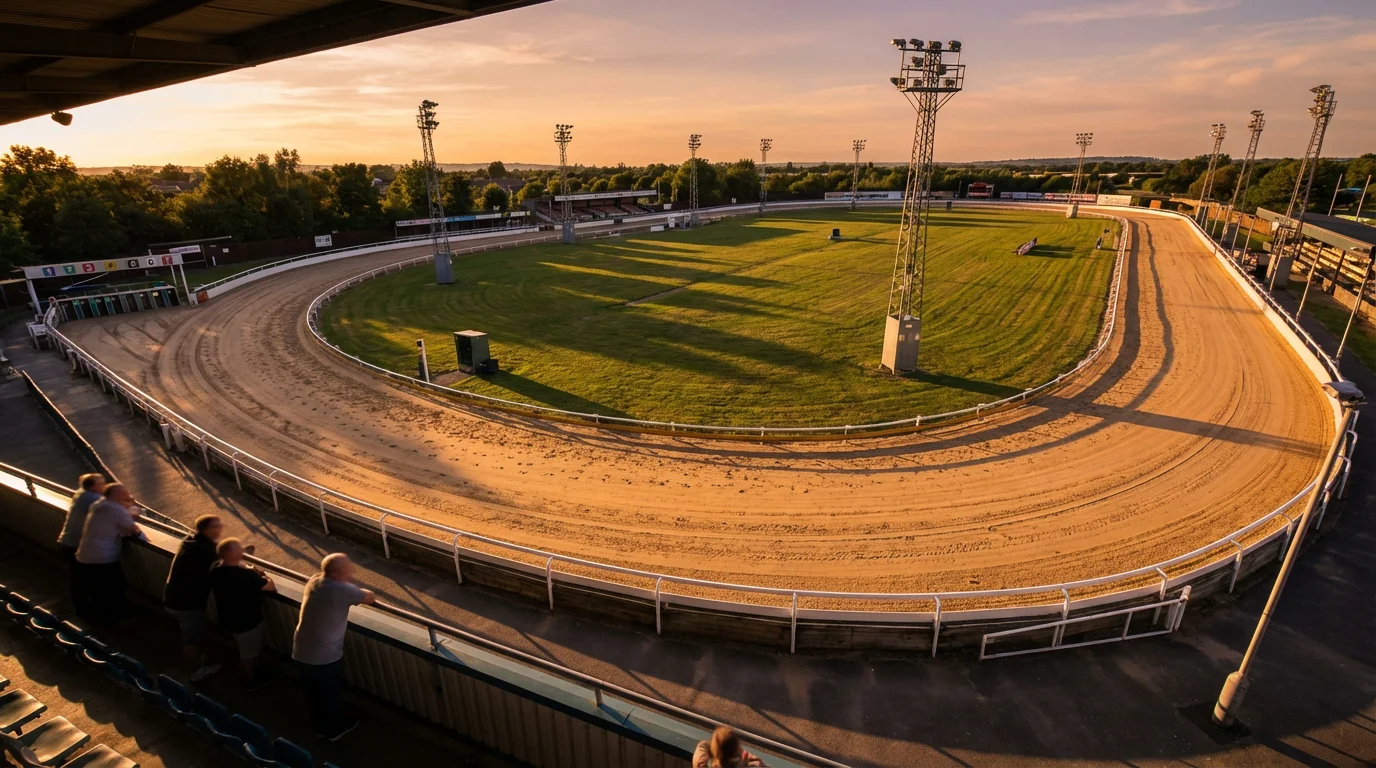
Twenty Tracks, Twenty Different Puzzles
In greyhound racing, form is only as good as the track it was recorded at. The UK has around twenty GBGB-licensed greyhound stadiums across England and Wales (GBGB), and each one races differently. Different circumferences, different bend geometry, different surfaces, different run-ups to the first bend. A dog that dominates at one track can struggle at another without any loss of ability — the track simply doesn’t suit it.
Punters who treat all tracks the same are leaving money on the table. A time of 29.50 over 480 metres means something entirely different at a tight, short-circumference track than it does at a wide galloping circuit. Trap bias patterns that hold at one venue may reverse at the next. The dog that hugs the rail and wins at Romford might get swallowed up at a track with wider, more sweeping bends where outside runners have room to operate.
This guide profiles the key UK greyhound tracks, explains what makes each one distinctive, and provides the reference data you need to assess form accurately when dogs race at venues you’re less familiar with. It starts with the mechanics of what makes tracks different, moves through the major circuits region by region, and closes with a comparison table you can bookmark. Start with the mechanics, then meet the tracks.
What Makes a Greyhound Track Different
Two 480-metre tracks can race completely differently. The distance is the same, but everything about how that distance is covered — bend tightness, surface grip, hare rail position, run-up length — shapes the racing dynamics and, by extension, the form produced there.
Circumference is the starting point. A track with a large circumference has longer straights and wider, more gradual bends. This rewards dogs with sustained speed and allows wide runners to maintain their line without losing as much ground through the turns. A smaller circumference means tighter bends, shorter straights, and a premium on early pace. Getting to the first bend in front matters more on a tight track because there’s less straight to make up lost ground. The tighter the bends, the more a railer benefits from an inside trap draw.
Bend radius directly influences trap bias. At tracks with sharp bends, inside traps have a measurably shorter path to the apex, which translates into a statistical win-rate advantage. At tracks with gentler curves, the difference between inside and outside is smaller, and the bias is less pronounced. This is why trap stats from one track don’t transfer to another — the geometry is different.
Surface matters too. Most UK greyhound tracks use sand, but a growing number have moved to all-weather surfaces that offer more consistent racing regardless of conditions. Sand tracks can ride slower after rain, which affects different running styles unevenly. Front-runners on fast sand can find themselves struggling when the surface slows. All-weather tracks produce more consistent times, which makes form comparison over time more reliable.
The run-up to the first bend — the distance from the traps to where the dogs enter the first turn — is an underrated variable. A long run-up gives dogs time to find their stride and establish position before the first bend. A short run-up means the dogs hit the bend quickly, which increases the likelihood of crowding and interference. Tracks with short run-ups to tight first bends tend to produce more trouble in running and more upsets, which is worth knowing when you’re assessing the predictability of a meeting.
Finally, hare type and position. Most UK tracks use an inside hare (rail), but some use an outside hare. The hare position affects how dogs run — an inside hare naturally draws the field toward the rail, while an outside hare encourages wider running. This interacts with trap draw and running style in ways that vary by track and by distance.
Central Park, Sittingbourne
Track Profile and Distances
Central Park’s 2023 renovation made it a different track. Situated in Sittingbourne, Kent, Central Park is operated by Arena Racing Company and underwent a significant upgrade that included new distances, resurfaced bends, and improved facilities. The track now runs on an all-weather surface, which has made times more consistent and reduced the weather-related variability that punters at sand tracks have to account for.
Current race distances are 277m (a short sprint, two bends), 450m (the mid-distance, four bends), 537m (the standard trip, four bends, and the most commonly raced distance), and 714m (the marathon, six bends). Hurdle races are also staged, typically over 537m. The 537m trip is the backbone of the schedule, with the majority of graded races run over this distance. The 714m serves as the venue’s stamina test and is the distance used for the Cesarewitch, Central Park’s flagship competition.
Central Park races on a regular schedule: morning meetings Monday to Thursday, broadcast via SIS, and a Friday evening card that typically draws stronger fields and higher-grade races. The morning meetings are BAGS-contracted, offering consistent betting coverage across UK bookmakers. The Friday evening cards are the week’s competitive highlight, attracting better dogs and fuller markets. For punters specialising in this track, the Friday meetings offer the deepest form to study and the most liquid betting markets.
The renovation didn’t just change distances — it changed the track’s racing character. The resurfaced bends run more evenly than before, reducing the inside-trap advantage that the old geometry produced. The all-weather surface means that morning meetings in January produce times comparable to those in July, which removes a layer of uncertainty that sand-track punters constantly navigate. For form students, this consistency is a gift: you can compare runs from different months with more confidence than at venues where the surface shifts with the weather.
Central Park Trap Stats and Betting Angles
Central Park’s geometry is forgiving — but the grades aren’t. Compared to tighter UK tracks, Central Park’s bends are relatively even and symmetrical, which produces a fairer distribution of trap wins across the six boxes. There’s no single trap that dominates the way Trap 1 can at a tight inner-city circuit. That said, distance-specific patterns still emerge.
At the shorter 277m and 450m distances, inside traps retain a modest edge because the run to the first bend is brief and dogs drawn low reach the rail first. At 537m, the bias flattens. The longer run-up and the way the field spreads through the first two bends give mid-draw and outside runners a fairer chance. At 714m, stamina overtakes position — the race is long enough that early-pace advantages wash out over six bends, and dogs with genuine staying power close the race regardless of where they started.
Early pace is rewarded more consistently at 277m and 450m than at the longer trips. Punters looking for front-runners to hold up should concentrate on the sprint distances, where leading at the first bend correlates strongly with winning. At 537m and particularly 714m, closers are competitive enough that favouring the dog with the fastest first-bend split isn’t a reliable shortcut.
Trainer patterns at Central Park are worth monitoring. A handful of local trainers target this track specifically, and their runners tend to be better prepared for its characteristics than visiting dogs. Checking trainer strike rates at Central Park — available through Timeform and similar services — can add a useful layer to your selection process, particularly in lower-grade races where the quality gap between well-placed and poorly-placed runners is larger.
Key UK Greyhound Tracks at a Glance
Southern Tracks: Romford, Hove, Crayford, Harlow
London and the south-east have the densest cluster of UK tracks, and each one runs to a different character.
Romford is the tightest major circuit in the country. Its small circumference produces sharp bends where inside traps dominate, particularly at sprint distances. Trap 1 at Romford carries a win-rate premium that few other tracks match. Early pace is king here — if a dog leads into the first bend, the track layout makes it extremely difficult for chasers to close the gap. The stadium hosts regular evening meetings with strong fields and is one of the most heavily bet-on tracks in the UK. For punters who specialise in identifying front-running railers, Romford is the ideal testing ground. The flip side of Romford’s tightness is that wide runners drawn in Trap 5 or 6 face a genuine disadvantage. Their wider racing line through the bends costs them lengths that the short straights don’t allow them to recover. Form from wide traps at Romford should be read with caution — a fourth-place finish from Trap 6 at this circuit might represent a better performance than it looks.
Hove, on the south coast near Brighton, is Romford’s opposite in many respects. It’s a bigger, galloping track with wider bends that produce fairer racing and a more even trap-bias profile. Dogs that race wide aren’t penalised as severely here, and the longer straights allow chasers to make ground. Hove hosts some prestigious open races and attracts quality fields, particularly at its feature distances. The form produced at Hove tends to translate well to other larger tracks, making it a valuable reference circuit. Hove also races over distances from 285m up to 970m, giving it one of the widest ranges in the country. Its marathon distance attracts stamina specialists and produces form that’s directly relevant to staying events at other large-circumference venues.
Crayford sits in south-east London and races over distances including 380m and 540m. Its bends are relatively sharp, giving inside traps an advantage that’s somewhere between Romford’s extreme bias and Hove’s neutrality. Crayford runs a busy schedule and its meetings are popular with London-based punters. The 380m sprint is a pure speed test where trap draw and early pace are the primary factors.
Harlow, in Essex, is a smaller track that hosts regular BAGS meetings. Its racing tends to be at a lower average grade than the London tracks, but that creates its own opportunity. The grading at smaller tracks can produce bigger class gaps within a single race, which means form analysis sometimes uncovers value that the market misses because fewer punters study these cards in depth.
Midlands & North: Perry Barr, Monmore, Nottingham, Sheffield
Head north and the tracks get tighter and the racing gets harder. The Midlands and northern circuits host some of the most competitive greyhound racing in the UK, and several have deep histories in the sport.
Perry Barr in Birmingham is one of the UK’s most established venues. It races over a range of distances and has historically been strong at longer trips, producing dogs with genuine stamina credentials. The track layout is mid-sized, with bends that are tighter than Hove but wider than Romford. Trap bias is moderate — inside traps hold an edge at sprint distances, but the bias diminishes at the standard and longer trips. Perry Barr has hosted rounds of major competitions and its Friday evening cards attract serious fields. The track’s long-standing reputation for quality means that form from Perry Barr carries weight when assessing dogs that subsequently race at other venues.
Monmore Green in Wolverhampton offers a competitive mix of distances and grades. It’s a well-maintained track with consistent surfaces and a reputation for producing form that travels — meaning dogs that perform well at Monmore tend to handle other tracks competently. The betting markets on Monmore races are liquid, and bookmaker coverage is strong. For punters looking beyond the south-east, Monmore is one of the most reliable tracks to follow.
Nottingham hosted the English Greyhound Derby in 2019 and 2020 while Towcester was temporarily closed (Nottingham Greyhound Stadium), and that brief tenure speaks to the quality of its facilities and racing surface. It’s a bigger circuit that rewards ability over position, with enough straight to allow quality dogs to overcome a poor break. The Derby has since returned to Towcester, but Nottingham still races a strong programme with a solid calendar of open and graded competitions, including the prestigious Eclipse Stakes.
Sheffield, racing at Owlerton Stadium, is one of the sport’s historic venues. The track is tight by modern standards, with sharp bends that produce a marked inside-trap advantage. Racing at Owlerton is fast and often physical, with first-bend crowding a regular feature at sprint distances. Punters who bet on Sheffield meetings should pay close attention to trap draw and early-pace form — both carry more weight here than at wider circuits. Owlerton’s character makes it a track where trouble in running is common, which means that form figures from Sheffield need careful reading. A dog that finished fifth after being bumped and checked through the first two bends has run better than the position suggests, and may offer genuine value next time from a more favourable draw.
Scotland & Specialist Venues: Shawfield, Newcastle, Sunderland
Shawfield was once the only GBGB-licensed track in Scotland, but it closed permanently in March 2020 due to COVID-19 and never reopened — its owner Billy King died in October 2022, ending any prospect of a return. Located in Glasgow, Shawfield operated with five runners per race instead of the standard six, which affected everything: trap bias patterns shifted because there was one fewer dog competing for space, forecasts and tricasts had different permutation maths, and the favourite’s win rate tended to be higher than at six-dog tracks simply because there was one fewer rival to worry about. While Shawfield is no longer operational, its legacy illustrates how five-dog fields alter the betting landscape, and any future five-dog formats at other venues would carry similar dynamics.
For bettors studying historical Shawfield form, the venue required a mental adjustment. Standard form analysis applied, but the absence of Trap 6 meant wide runners had more room, first-bend crowding was less frequent, and outsiders had a marginally better statistical chance of placing. The smaller field size also meant that forecast and tricast permutations were cheaper — a combination tricast on three dogs in a five-runner race was the same six units as in a six-runner field, but you covered three of five runners rather than three of six, which shifted the probabilities in your favour. The Scottish Greyhound Derby, which was held at Shawfield from 1970 to 2019, was discontinued following the stadium’s closure (GBGB). As of 2025, there are no active GBGB-licensed tracks in Scotland.
Newcastle and Sunderland serve the north-east and both feature regularly in BAGS broadcasting schedules, meaning consistent bookmaker coverage and reliable market formation. Newcastle is a mid-sized track with a solid schedule of morning and afternoon meetings. Its form tends to be internally consistent — dogs that perform well there tend to repeat at the same venue, making it a good track for punters who study trends over weeks and months.
Sunderland races at a similar level and schedule to Newcastle, with enough meetings to provide the data volume that form analysis requires. Neither track hosts the sport’s headline events, but both offer regular opportunities for disciplined punters who are prepared to study the less glamorous cards where public attention — and therefore bookmaker scrutiny — is lighter. Less scrutiny means more pricing inefficiency, and pricing inefficiency is where profit lives.
Quick Comparison: Track Characteristics Table
Before you bet on a dog at a new track, check the specs. The following table summarises the key characteristics of the major UK greyhound tracks for quick reference.
| Track | Surface | Key Distances | Trap Bias | Circuit Size | Meeting Schedule |
|---|---|---|---|---|---|
| Central Park | All-weather | 277m, 450m, 537m, 714m | Slight inside at sprints, even at 537m+ | Medium | Mon-Thu AM, Fri PM |
| Romford | Sand | 225m, 400m, 575m | Strong inside | Small | Mon, Wed, Fri, Sat PM |
| Hove | Sand | 285m, 515m, 695m, 970m | Relatively even | Large | Tue, Thu, Sat PM |
| Crayford | Sand | 380m, 540m, 714m | Moderate inside | Medium | Mon, Wed, Sat PM |
| Perry Barr | Sand | 274m, 480m, 630m, 816m | Moderate inside | Medium-Large | Mon, Wed, Fri PM |
| Monmore | Sand | 264m, 480m, 630m | Slight inside | Medium | Tue, Thu, Sat PM |
| Nottingham | Sand | 305m, 500m, 680m | Relatively even | Large | Tue, Thu, Sat PM |
| Sheffield | Sand | 280m, 460m, 660m | Strong inside | Small | Mon, Thu, Sat PM |
| Shawfield (Closed) | Sand | 270m, 480m, 684m | Moderate inside (5 dogs) | Medium | Closed since 2020 |
| Newcastle | Sand | 275m, 480m, 640m | Slight inside | Medium | Mon-Sat AM/PM |
| Sunderland | Sand | 261m, 450m, 640m | Moderate inside | Medium | Mon-Sat AM/PM |
| Harlow | Sand | 238m, 415m, 592m | Moderate inside | Small-Medium | Mon-Fri AM |
Distances and schedules can change between seasons, and some tracks adjust their programmes around major events or broadcaster contracts. Use this table as a starting framework, then verify the specifics through the track’s official site or the GBGB before placing bets based on track data. The core characteristics — surface, size, and bias direction — are structural and remain consistent over longer periods.
Home-Track Knowledge Beats General Expertise
The best track is the one you study until the data makes noise. The most profitable greyhound punters don’t spread themselves across twenty tracks. They pick two or three, learn every quirk, and develop an understanding of form patterns that no casual observer can match.
Specialising in a track means learning which trainers target it, which trap draws produce at specific distances, how the surface behaves in different conditions, and which graded races tend to throw up competitive fields versus mismatches. Over months of following the same track, you start to recognise dogs by name, remember their previous runs, and spot when the grading system has placed a runner in a race where it holds a clear edge. That depth of knowledge is something the bookmaker’s algorithms can replicate in theory, but the average punter never develops in practice.
If you’re reading this guide to choose a track, consider what’s available to you. Check the broadcasting schedule — are the meetings on at times you can follow? Check the bookmaker coverage — are prices competitive and is BOG available? Check the data — are racecards, form, and results easily accessible? Then commit. Follow the results, study the cards, build your records.
Central Park, with its consistent all-weather surface and frequent schedule, is an excellent track for this kind of deep specialisation. But the principle applies everywhere. Whether you choose Romford for its tactical intensity, Hove for its fairer racing, or Monmore for its competitive depth, the approach is the same: go deep on one circuit before you go wide across many. The punters who know one track will always outperform those who know twelve tracks superficially.
Find more track guides at centralparkgreyhound.
Also read our ARC greyhound tracks.
