
Greyhound Ante-Post Betting: Risks & Rewards
 Available in US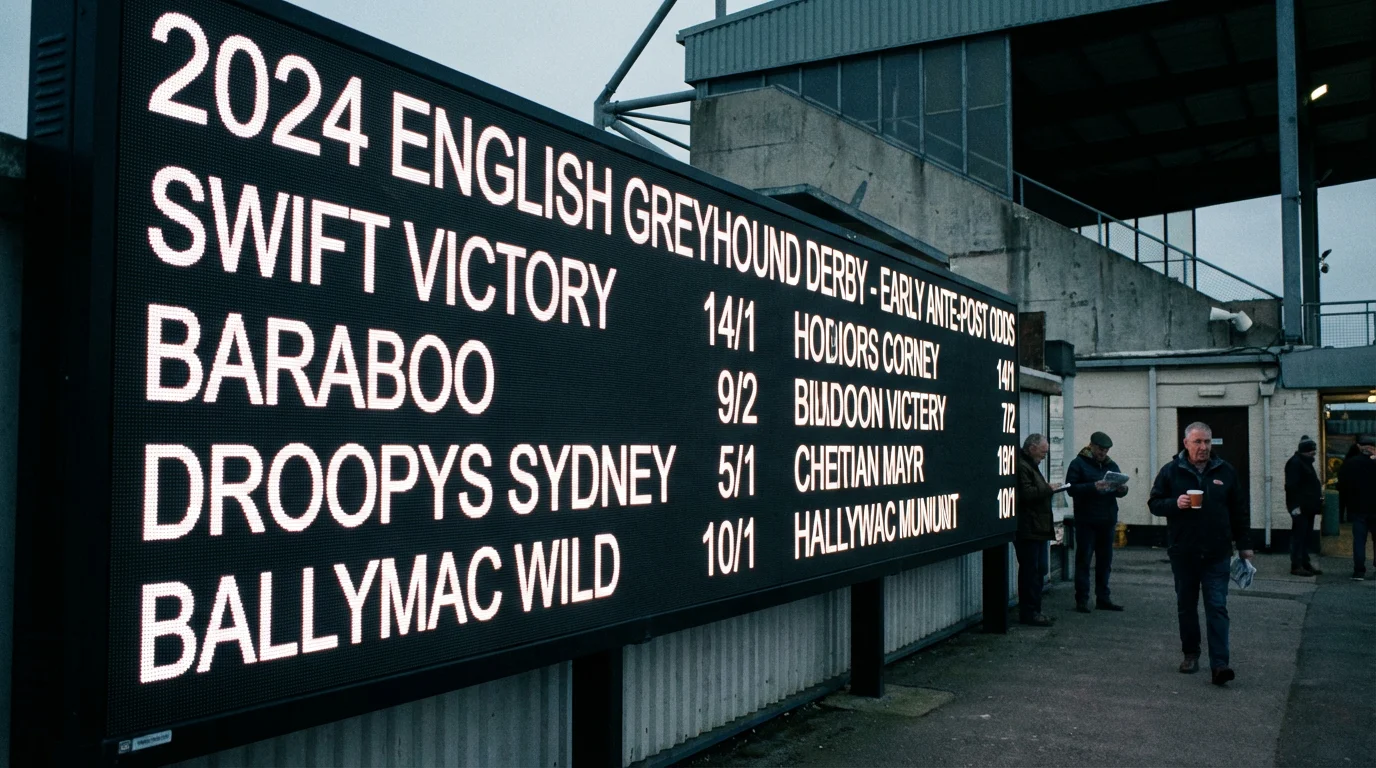
Betting Before the Race Is Even Set
Ante-post betting means placing a bet on a greyhound event before the final declarations have been made — sometimes weeks or months before the race itself. The prices are longer because the uncertainty is greater: dogs may be withdrawn, injured, eliminated in earlier rounds, or simply fail to make the final field. That risk is the trade-off for odds that can be significantly more generous than anything available on the day of the race.
In greyhound racing, ante-post markets primarily exist for major competitions: the English Greyhound Derby, the Cesarewitch, the Springbok, regional derbies, and other Category events. These are multi-round competitions where the outright winner market opens early and adjusts as heats and semi-finals resolve. For punters who follow the sport closely and are prepared to accept the risk of non-runners, ante-post betting offers some of the best value in the greyhound calendar.
How Ante-Post Markets Work in Greyhound Racing
Ante-post markets open when a bookmaker publishes prices on the entries for a forthcoming competition. For an event like the Cesarewitch at Central Park, initial prices might appear several weeks before the first heat, based on the entered dogs’ known form, connections, and perceived quality. The market evolves as information emerges — trial performances, kennel reports, early-round results — and the prices adjust accordingly.
The key difference from day-of-race betting is that ante-post bets are typically struck on an “all-in” basis, meaning your bet stands regardless of whether the dog actually participates. If you back a dog ante-post and it is subsequently withdrawn due to injury, fails to qualify through the heats, or is scratched for any other reason, your stake is lost. There is no refund and no Rule 4 adjustment. The price you received was generous precisely because it included the risk of non-participation.
Some bookmakers offer “non-runner no-bet” terms on selected ante-post greyhound markets. Under these terms, if your selection does not make the final field, your stake is returned. The prices under NRNB terms are shorter than standard all-in prices because the bookmaker has reduced the punter’s risk and needs to compensate by offering less generous odds. Whether the tighter price under NRNB or the longer price under all-in terms offers better value depends on your assessment of the dog’s likelihood of making the final.
Prices in ante-post greyhound markets can move significantly as the competition progresses. A dog that wins its heat impressively will shorten sharply for the outright market. One that scrapes through or looks below-par may drift. These movements create both opportunities and traps — a dog that has shortened dramatically after a good heat may no longer represent value even if it is the most likely winner, while a dog that has drifted after a moderate heat may be undervalued if the performance had legitimate excuses.
All-In Rules and What They Mean for Your Stake
The all-in rule is the central risk of ante-post greyhound betting. When you bet all-in, you are not just backing the dog to win the competition — you are also accepting the risk that it might not compete in the competition at all. This dual uncertainty is what justifies the longer prices, and it is what separates ante-post from standard day-of-race betting.
Understanding the sources of non-participation helps you assess the risk. Injury is the most common cause — greyhounds are athletes operating at the edge of their physical capacity, and muscular, skeletal, and ligament injuries can occur in training or during earlier rounds of the competition. Season (for bitches) can cause withdrawal at any point. Illness in the kennel can affect multiple entries from the same trainer. Failure to qualify through the heats eliminates dogs that were not good enough on the day, regardless of their pre-competition reputation.
The practical question before any ante-post bet is: what is the probability that this dog makes the final? If you estimate a 75 percent chance of participation and the ante-post price is 8/1, the effective price — adjusted for the non-participation risk — is roughly 6/1 (since 25 percent of the time your stake is dead). If the dog would be a fair 4/1 shot in the final, the effective 6/1 still represents value. If it would be 7/1 in the final, the ante-post price barely compensates for the non-participation risk, and waiting for the day-of-race market may be wiser.
Finding Value in Ante-Post Markets
The best ante-post value exists in the earliest stages of a market, before the heats have resolved and before the wider betting public has focused on the competition. At this point, the bookmaker’s prices are based on general form assessment and reputation rather than competition-specific data, and the market is thinnest. A punter with detailed knowledge of the entered dogs — their track-specific form, their distance preferences, their trainer’s competition record — can identify mispricings that disappear once the heats provide public information.
Track specialists are a recurring source of ante-post value, particularly in competitions like the Arena Racing Company Cesarewitch at Central Park (Central Park — Cesarewitch). A dog with proven form at the specific venue and distance, trained by a kennel with a strong record at that track, holds a genuine advantage that the wider ante-post market — which prices dogs primarily on overall form rather than track-specific suitability — may undervalue. The gap between “general ability” pricing and “track-specific probability” is where informed ante-post punters find their edge.
Timing matters. Taking a price before the first heat captures the maximum uncertainty premium — the market has not yet resolved any of the open questions about participation, fitness, and competition form. Taking a price after the first round, once you have seen the dog compete under event conditions, sacrifices some of the price premium but eliminates a significant portion of the non-participation risk. Both approaches have merit. Early movers get better prices with more risk; later movers get shorter prices with better information.
Managing Ante-Post Exposure
Ante-post betting should never consume a significant portion of your betting bank. The combination of long odds, all-in risk, and extended time horizons creates a variance profile that is fundamentally different from day-of-race betting. A sensible ceiling is 3 to 5 percent of your total bank allocated to ante-post positions across all active competitions.
Diversification within that allocation reduces the impact of any single non-runner. Rather than placing your entire ante-post budget on one dog in one competition, spread it across two or three selections in different events, or take multiple positions within the same competition at different price points. If your first ante-post selection in the Cesarewitch is withdrawn after the heats, a second position on a different dog can offset the loss.
Reassessing your positions as the competition progresses is essential. After each round, the available information changes, and the market adjusts. A dog you backed at 10/1 before the heats may now be 3/1 after winning impressively. At this point, you have an unrealised profit in your position — the value is already captured in the price movement, and the remaining risk is the final itself. Some punters choose to lay off part of their position on the exchange, locking in a guaranteed profit regardless of the final result. Others let the position run, accepting the all-or-nothing outcome. The right approach depends on your risk tolerance and the size of the position relative to your bank.
Keep records of every ante-post bet, including the ones that are voided by non-participation. Over several competition cycles, these records reveal your hit rate on participation assessment and your ability to identify value at the ante-post stage. If your ante-post selections consistently make the final but finish out of the places, your form reading is good but your value assessment needs work. If they consistently fail to participate, your risk assessment of non-runners needs recalibration.
Patience Is the Ante-Post Edge
Ante-post greyhound betting rewards preparation, patience, and a tolerance for lost stakes. The prices are longer because the risk is real — dogs get injured, fail to qualify, and disappoint under competition conditions. But the punter who studies the entries, assesses the track-specific suitability, estimates the participation probability, and takes the price when the value is clear will, over a series of competitions, collect returns that day-of-race betting cannot match.
The discipline is in the selectivity. Not every competition offers ante-post value. Not every entered dog warrants a bet. The ante-post punter who places two or three carefully researched positions per year, at prices that genuinely compensate for the risk, will outperform the one who bets every major competition because the market is open. Back less, back better, and give the prices time to prove you right.
Find more strategy guides at centralparkgreyhound.
Also read our greyhound betting promotions.
