
Kennel & Trainer Form in Greyhound Betting
 Available in US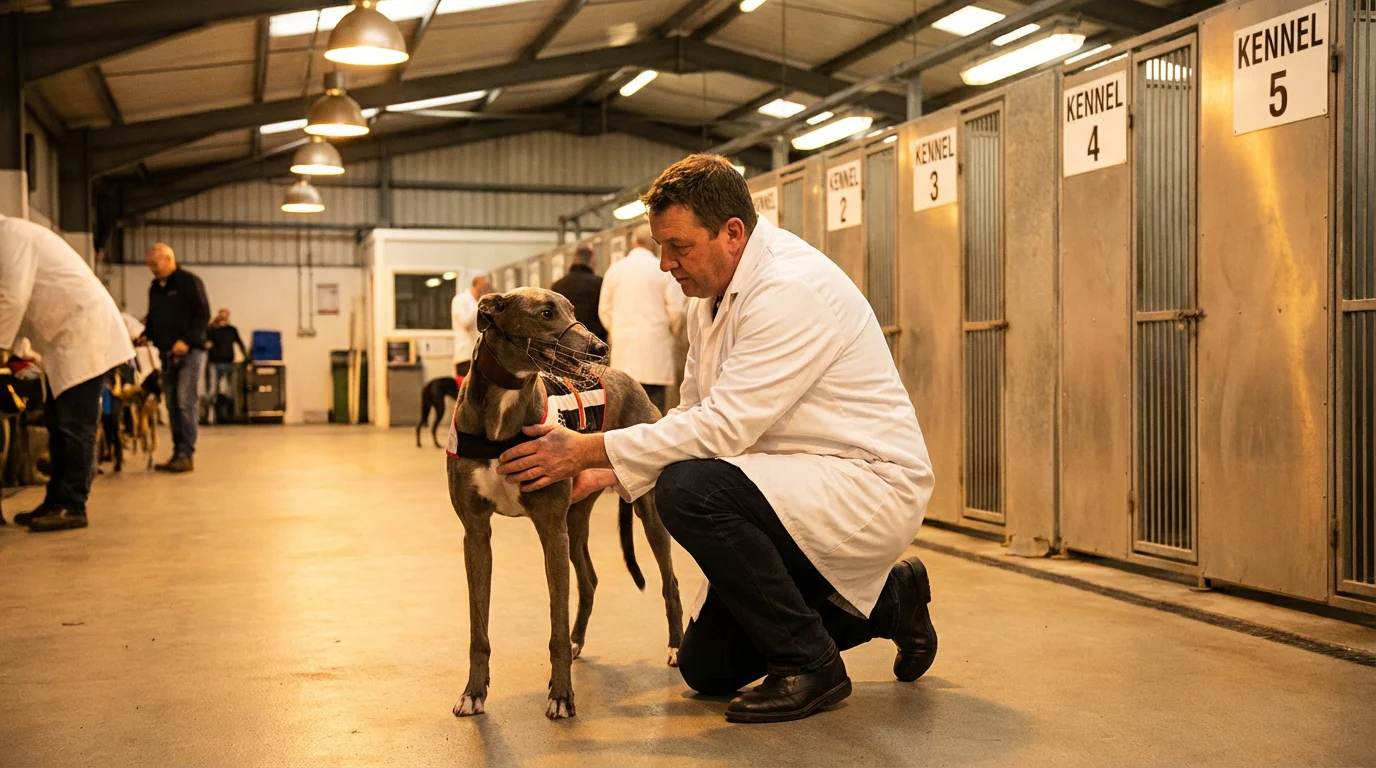
The Name on the Racecard You Keep Ignoring
Every greyhound racecard shows the trainer’s name next to the dog. Most punters glance at it and move on. That is a missed opportunity, because the trainer’s name is shorthand for a system — a feeding regime, a training programme, a scheduling philosophy, and a relationship with specific tracks that directly influences how likely the dog is to perform on any given night.
Trainer form is one of the most underused data points in greyhound betting. It is publicly available, easy to track, and carries predictive value that rivals trap draw and speed ratings in certain circumstances. This guide explains why trainers matter, how to analyse their strike rates, and how to incorporate trainer data into your selections without overcomplicating your process.
Why Trainers Matter More Than You Think
A greyhound trainer controls almost every variable in a dog’s preparation. Diet, exercise intensity, rest periods, trial scheduling, race entry choices, kennel conditions, and the decision of when to race a dog and when to rest it are all trainer decisions. Two dogs of identical raw ability, prepared by different trainers, can produce visibly different results on the track because the quality of preparation differs.
Trainers also make the tactical decisions that appear on the racecard. They choose which meetings to enter a dog in, which distances to target, and sometimes influence the trap draw through the entry process. A trainer who consistently enters a wide-running dog at tracks that favour outside runners is making a smart placement decision that will not show up in the form figures but will show up in the dog’s results over time.
The most tangible impact of trainer quality is visible in how dogs from the same kennel perform relative to their ability. A top kennel sending ten runners to a meeting might produce three or four winners, a strike rate well above the statistical expectation. A weaker kennel with dogs of comparable grading might manage one winner from the same number of runners. The difference is preparation, and it compounds across dozens of meetings into a measurable statistical pattern.
Strike Rate Analysis: Reading the Numbers
Trainer strike rate — the percentage of runners that win — is the most straightforward measure of kennel form. A trainer with a 20 percent strike rate over the last three months is producing winners at a rate significantly above the 16.7 percent that random chance would predict in six-runner races. A trainer at 10 percent is underperforming, and their dogs should be viewed with extra caution regardless of how their form figures look.
The time window matters. A trainer’s career strike rate is less useful than their recent form, because kennels go through hot and cold periods just like individual dogs. A kennel that was striking at 25 percent three months ago may be running at 8 percent now due to illness in the kennel, a key staff change, or simply a batch of dogs reaching the end of their competitive peak simultaneously. Always check recent trainer form — the last 14 to 30 days is the most relevant window.
Sample size complicates the analysis. A small kennel that sends out five runners a week will produce volatile strike rate figures — three winners in one week is a 60 percent rate, but it does not mean the kennel is three times better than one running at 20 percent. It means the sample is too small to be reliable. Larger kennels with twenty or more runners per week produce more stable statistics that you can trust as genuine indicators of form rather than statistical noise.
Place strike rate — the percentage of runners finishing in the top two — is a useful complement. A trainer whose dogs are consistently finishing first or second, even when they are not winning, is running a kennel in good health. Their dogs are competitive, which means the form figures are reliable and the dogs are likely to remain in contention. A trainer whose dogs are finishing fifth and sixth regularly, regardless of grade, is running a kennel with broader issues that affect every runner they send out.
Track Specialisms: Home Advantage for Kennels
Just as individual dogs perform better at certain tracks, trainers develop specialisms at specific venues. A trainer based near Central Park who sends the majority of their runners there will know the track intimately — how the surface behaves in different weather, which distances suit which types of dog, and how the grading manager tends to assess their runners. This familiarity translates into a measurable home-track advantage.
The data supports this consistently. Trainers with a high proportion of runners at a single track tend to outperform their strike rate at other venues. A trainer who strikes at 22 percent at Central Park but only 12 percent elsewhere is not a worse trainer on the road — their Central Park number reflects the accumulated advantage of track knowledge, relationship with the racing office, and optimised preparation for that specific surface and configuration.
For bettors, trainer track specialism is particularly valuable when a dog transfers between venues. A dog moving from a kennel with a strong Central Park record to race at Central Park for the first time still benefits from its trainer’s knowledge of the track, even though the dog itself has never raced there. The trainer knows where to enter it, what distance to target, and how to prepare it for the specific demands of the venue. This is an edge that the racecard does not make explicit but that trainer data reveals.
Conversely, a top-rated kennel sending a dog to an unfamiliar track deserves a note of caution. The trainer’s overall strike rate may be excellent, but their record at the away venue may be significantly weaker. Checking trainer form by track rather than in aggregate adds a layer of precision to your assessment.
Integrating Trainer Data into Your Selections
Trainer form should function as a modifier in your analysis, not a primary selection criterion. You would not back a dog purely because its trainer has a high strike rate, just as you would not back a dog purely because it is drawn in Trap 1 at a track with inside bias. But when your form analysis produces two or three dogs that are difficult to separate, trainer form can be the tiebreaker that tips the balance.
The practical integration works like this. After studying the racecard and forming your initial view of the race, check the trainer strike rates for each runner. If your preferred selection is trained by a kennel in strong current form, that is a confidence boost — the preparation behind the dog supports your form assessment. If your preferred selection is from a kennel that has been struggling, ask whether the form you are looking at was achieved during the kennel’s good period and whether the current slump might affect tonight’s run.
Hot kennels — trainers on a sustained winning streak — deserve particular attention. A kennel that has produced five or six winners from its last twenty runners is operating at a level that benefits every dog in the kennel, not just the obvious contenders. Their less fancied runners may outperform their odds because the kennel’s collective preparation quality is lifting them. Backing a mid-priced dog from a hot kennel can offer value that the market, which prices dogs individually rather than by kennel, occasionally misses.
Cold kennels warrant the opposite treatment. When a normally reliable trainer goes through a winless spell of three or four weeks, something is off — whether it is a virus in the kennel, a change in staff, or simply a bad run of luck with the grading system. Until the results turn around, downgrading runners from cold kennels by a notch in your assessment is a prudent adjustment.
The Trainer Is the System Behind the Dog
A greyhound does not prepare itself for race night. It is fed, trained, rested, trialled, and entered by a human who makes dozens of decisions in the days and weeks before the race, each of which influences the likelihood of a good performance. The trainer’s name on the racecard is the compressed output of all those decisions, and paying attention to it — tracking the strike rates, noting the track specialisms, monitoring the hot and cold cycles — gives you an information edge that the majority of punters leave on the table.
It takes five minutes per meeting to check trainer form. The return on those five minutes, compounded across a season of betting, is worth considerably more than the time invested.
Get more form data at centralparkgreyhound.
Also explore our greyhound form guide.
