
How Starting Price Works in Greyhound Racing
 Available in US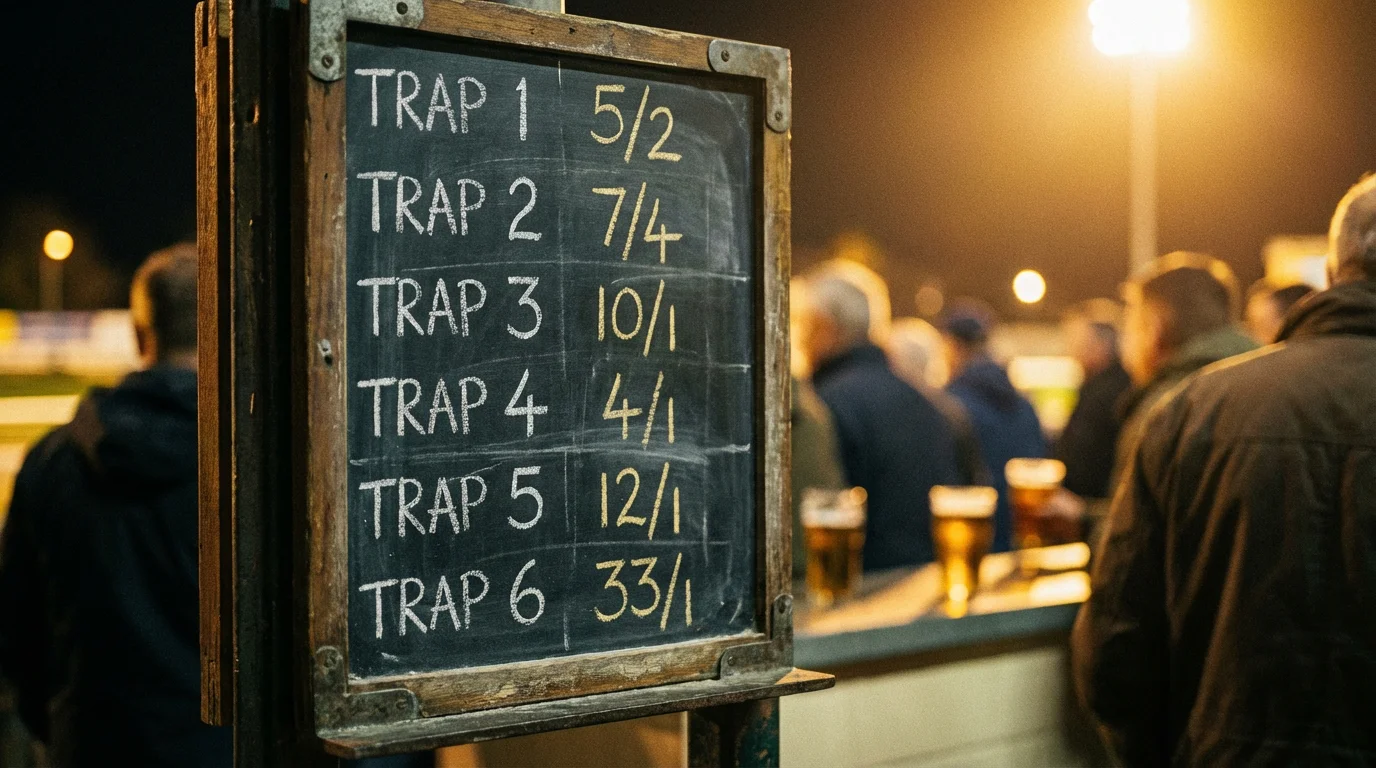
SP: The Final Price Before the Traps Open
Starting price is the market’s last word — and it is not always fair. SP is the odds assigned to a greyhound at the exact moment the traps open, representing the final state of the on-course betting market. Every punter who does not take a fixed price with their bookmaker before the race is settled at SP, whether they chose that deliberately or simply did not get around to clicking the odds in time.
For a concept so central to greyhound betting, SP is surprisingly poorly understood. Many punters treat it as a given — the price is what the price is — without asking how it was formed, whether it represents fair value, or whether they would have been better off taking an earlier price. That passivity costs money over time. Understanding how SP works, when to take it, and when to avoid it is one of the quieter skills that separate break-even punters from profitable ones.
How SP Is Determined at the Track
SP is a snapshot of the betting market at the moment the traps open. In greyhound racing, the mechanism for determining starting prices differs depending on the type of meeting and the level of on-course activity.
At attended evening meetings — Friday nights at Central Park, for example — on-course bookmakers display their odds on boards. As punters place bets, the bookmakers adjust their prices to balance their books. Heavy money on a particular dog shortens its price; lack of interest in another sees its odds drift outward. The SP is the final price displayed by the on-course bookmakers at the moment the race starts. An official SP returner records these prices and declares the official starting price for each runner.
For the bulk of UK greyhound racing, however, meetings run without a significant on-course betting presence. Daytime BAGS and SIS meetings at tracks like Central Park run on weekdays with minimal trackside attendance. In these cases, SPs are derived from the off-course market — essentially a calculation based on the betting patterns at major online and high-street bookmakers. The prices you see on your screen before the off are the prices that form the basis of the declared SP.
This distinction matters for bettors. At attended evening meetings, SP reflects a genuine, visible market with real money flowing in at the track. At unattended morning meetings, SP is an aggregate of off-course activity, which can be thinner and more susceptible to distortion by a single large bet or a coordinated move from a small group of punters. The reliability of SP as a measure of true probability varies depending on the depth and quality of the market behind it.
Morning prices — the odds offered by bookmakers when markets first open, often several hours before the race — can differ substantially from the eventual SP. A dog priced at 5/1 in the morning market might start at 3/1 if money arrives for it during the day, or drift to 8/1 if the market moves against it. The morning price is a bookmaker’s opening assessment. The SP is where that assessment ended up after the market had its say.
SP vs Taking a Price: When Each Works
Take the price when you think you have found value. Take SP when you are unsure. That is the simplest heuristic, and it covers more situations than any complex framework.
When you study a racecard, form your own opinion on a dog’s chance, and see a price that exceeds your assessment of its probability, locking in that price immediately is the disciplined play. If you rate a dog at roughly 25 percent to win and its current price is 5/1 — implying about 17 percent — the value is clear and present. Waiting for SP risks the price shortening as other punters reach the same conclusion, leaving you with a worse return on a bet you had already decided to make.
Dogs that are likely to be steamers — runners whose price will shorten significantly before the off — are prime candidates for early price taking. The tells are usually visible in the form: a class dropper with obvious ability, a dog returning to its preferred distance and trap, or a runner from a kennel in outstanding recent form. When the market has not yet fully processed these factors, the early price offers an edge that will evaporate by race time.
Drifters present the opposite case. A dog whose price is likely to lengthen before the off — perhaps because of an unfavourable draw, a step up in class, or a kennel going through a cold spell — is one where SP may be more generous than the current price. If you fancy the dog despite the negatives, waiting for the drift can get you better odds. The risk is that the price drifts for a reason — the market is telling you something your analysis may have missed.
The honest middle ground is that most punters cannot consistently predict market direction. For the majority of bets, taking the current price when your analysis is complete is the most practical approach. It removes the second-guessing, the clock-watching, and the regret of having waited too long or acted too soon.
Best Odds Guaranteed on Greyhounds
BOG removes the guesswork — take early, get SP if it is better. Best Odds Guaranteed is the single most punter-friendly feature available in greyhound betting, and any serious bettor should be placing their bets with bookmakers that offer it.
The premise is simple. You take a fixed price on your selection at any point before the race. If the SP is higher than the price you took, the bookmaker pays you at the better SP instead. If the SP is lower, you keep your original price. You get the best of both worlds — the security of a locked-in price with the upside of any late market drift.
In practice, BOG works like this. You back a dog at 4/1 two hours before the race. By the time the traps open, the SP has drifted to 6/1. With BOG, your bet is settled at 6/1, not 4/1. Had the SP shortened to 3/1 instead, you would still be settled at your original 4/1. The mechanism automatically applies the more favourable price to your bet.
The scope of BOG on greyhounds varies by bookmaker. Most major UK operators offer BOG on BAGS and SIS meetings, which covers the majority of daily greyhound racing. Some extend it to all greyhound meetings; others restrict it to specific meeting types or apply daily limits on the additional liability they will absorb. Checking the terms at your preferred bookmaker is worth the five minutes it takes — the differences between operators can be meaningful over a season of betting.
The strategic implication of BOG is that it makes early price-taking almost always the correct approach when the offer applies. There is no longer a penalty for acting early. If the price you take is good, you keep it. If the market moves in your favour, you benefit automatically. The only remaining reason to wait for SP when BOG is available is if you genuinely believe the early market is inflated and will shorten — in which case you are betting against your own assessment of value.
Building SP into Your Betting Approach
Your SP strategy should depend on how much information you have before the off. This sounds obvious, but it runs counter to how most punters operate. The default behaviour is to study the racecard, make a selection, and then either take whatever price is showing or drift into SP by default. Neither approach is optimal.
For meetings where you have studied the card in advance — perhaps a Friday evening Central Park meeting where the racecards are available from mid-afternoon — taking a price early is generally the stronger play, especially if BOG applies. You have done the analysis, you have a view, and the current price either represents value or it does not. Waiting adds nothing except the risk of a worse price.
For meetings where you are betting closer to the off — a morning SIS meeting where you are making quick selections between races — SP becomes more defensible. You have less time for analysis, less confidence in your assessments, and less information about how the market has moved. In these situations, letting the market do its work and settling at SP avoids the risk of locking in a price that the market is about to correct.
Monitor how often SP would have been better or worse than the price you took. Over fifty or a hundred bets, this data tells you whether your timing instincts are adding value or costing it. If SP consistently outperforms your taken prices, you are acting too early. If your taken prices consistently beat SP, your early analysis is sharp and you should trust it more.
Price Is Timing
Bet when you are ready, not when the market tells you to. The price you accept reflects the moment you made your decision — and good punters are decisive about both the selection and the price.
SP is not inherently good or bad. It is simply the price that remains after every other opinion has been expressed. Sometimes it represents fair value. Sometimes it has been compressed by late money that you could have avoided by acting earlier. Sometimes it has drifted to a level that rewards the patient punter who waited.
The skill is in knowing which scenario you are in before it arrives. Study the form, assess the likely market direction, use BOG when available, and take the price at the point where your analysis is complete and your conviction is clear. Everything after that is the market’s problem, not yours.
Find more odds guides at centralparkgreyhound.
Also explore our UK greyhound odds guide.
