
Understanding Greyhound Grades: A1 to D4
 Available in US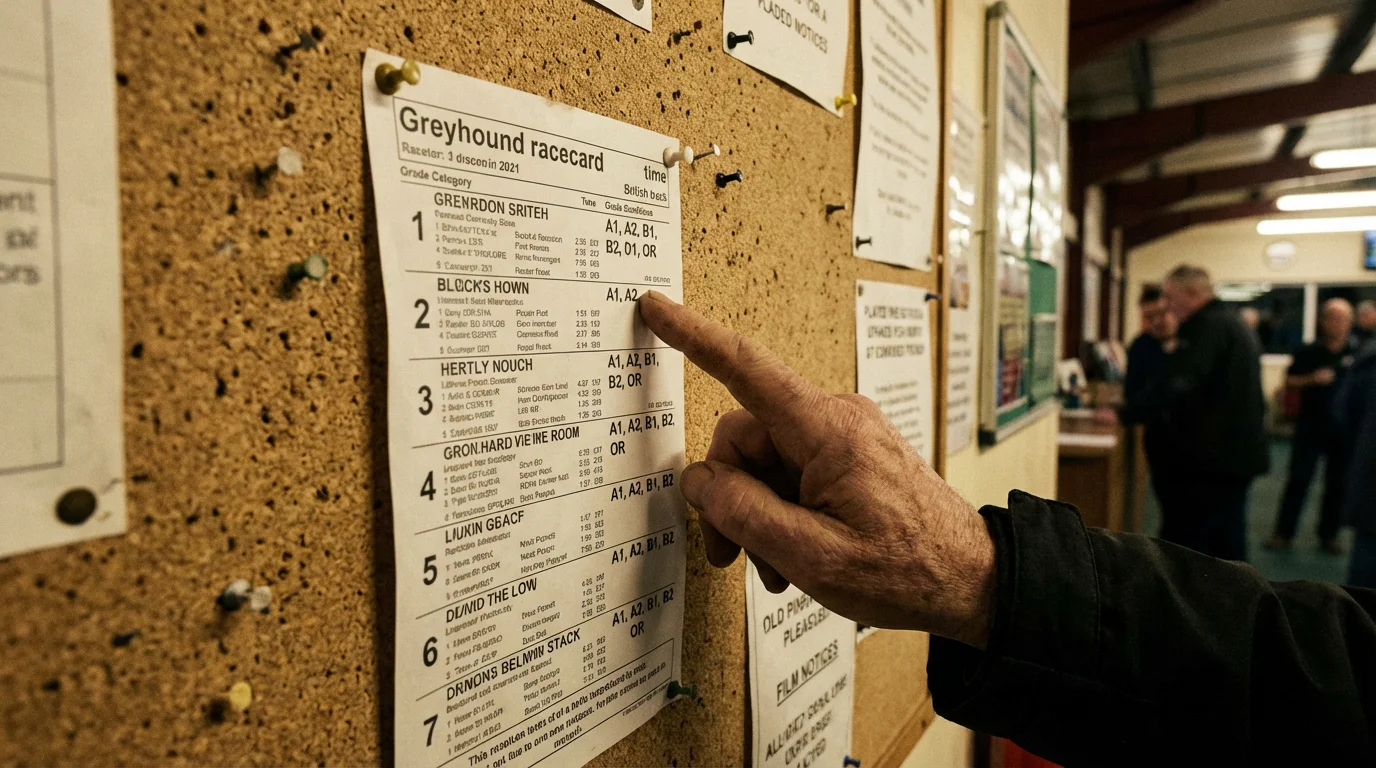
Grades Define the Race Before It Starts
Greyhound grades are the hidden scaffolding behind every racecard. Before you look at form figures, sectional times, or trap draws, the grade of the race has already told you something fundamental: what level of dog you are dealing with and how competitive the field should be.
The grading system exists to create fair, competitive races. Without it, the fastest dogs in the country would be running against dogs half their quality, producing processional results and destroying any meaningful betting market. Grades cluster dogs of similar ability together so that every race is, in theory, a genuine contest. For bettors, understanding how the system works — and where it creates opportunities — is essential context for every selection you make.
Most punters know that A1 is better than D4. Far fewer understand what happens in the spaces between grades, why the same grade label means different things at different tracks, or how movement between grades creates some of the best value opportunities in the sport.
The UK Grading System: A1 to D4
A3 at Central Park is not the same as A3 at Romford — the dogs are different, the standard shifts. This is the first thing to grasp about UK greyhound grading: the system is track-specific, not national. Each GBGB-licensed stadium operates its own grading structure based on the pool of dogs racing there, and the quality within any given grade varies significantly between venues.
The basic architecture is a letter-number combination. The letter indicates the broad class band: A is the highest, followed by B, C, and D. Some larger tracks extend to S grades below D or use additional sub-bands. The number indicates the subdivision within that class: 1 is the best, and the numbering increases downward. An A1 race features the track’s top graded performers. A D4 race features the weakest. The full range at a busy track like Central Park or Romford might run from A1 down to D4, giving perhaps twelve to sixteen distinct grades across the spectrum.
Grading is based primarily on recent race times at the track. The racing manager assigns dogs to grades by evaluating their finishing times over the standard distances, adjusting for going conditions. A dog that consistently runs times within the A3 band at its home track will race in A3 unless its form changes significantly. New arrivals — dogs transferring from another stadium — are graded based on their form at the previous venue, converted to the new track’s time standards. This conversion is imprecise, which is one reason why track transfers create betting opportunities.
The grading bands are not uniform across tracks because the population of racing dogs differs. A busy London track with a large pool of quality animals will have a higher standard in its A grades than a smaller regional venue. This means an A3 dog at Romford might be faster in absolute terms than an A1 dog at a less competitive track. The grade tells you where the dog sits relative to its own track’s population, not where it sits on a national scale.
Sprint distances, middle distances, and staying distances often have separate grading ladders at the same track. A dog might be graded A3 over 450 metres but B1 over 277 metres if its time profile suits the longer trip. Distance-specific grading means the grade on the racecard is always tied to the distance being raced, not to the dog’s overall quality as a blanket judgement.
How Dogs Move Between Grades
A dog dropping from A2 to A4 is not declining — it is finding its level. Grade movement is the mechanism by which the system self-corrects, and understanding it gives bettors a significant edge in identifying value.
Promotion happens when a dog wins or runs times that exceed its current grade band. A convincing victory in an A4 race, particularly with a fast finishing time, will typically see the dog raised to A3 for its next outing. The logic is straightforward: the dog has demonstrated it is too good for its current company and needs to face stronger opposition to maintain competitive balance.
Demotion follows the opposite pattern. A dog that finishes in the lower half of the field across two or three consecutive races, or posts times below its grade standard, will be dropped down. The racing manager reviews each dog’s recent form after every meeting and adjusts grades accordingly. This is not a rigid formula — there is discretion involved, particularly when a dog’s poor results were influenced by trouble in running rather than a genuine decline in ability. But the general direction is clear: win and go up, lose and come down.
The yo-yo effect is common among dogs that sit on the boundary between two grades. A dog might win an A5 race, get promoted to A4, struggle against the tougher opposition, drop back to A5, win again, and repeat the cycle. These dogs are not inconsistent in ability — they are consistently right at the dividing line between two levels. For bettors, yo-yo dogs create predictable patterns. Back them when they drop, avoid them when they rise.
Class drops after a spell away from racing also deserve attention. A dog returning from injury or a rest period is often dropped a grade or two as a precaution, regardless of its pre-absence ability. If the reason for the layoff was minor and the dog’s underlying quality is intact, the class drop gives it a genuine advantage over dogs that have been consistently racing at that lower level. These situations regularly produce short-priced winners, but the value depends on how much of the drop the market has already priced in.
What Grades Mean for Your Bets
Never compare form across grades without adjusting your expectations. A dog that finished second in an A2 race has almost certainly performed better than a dog that won an A5 race, even though the bare form figures suggest the opposite. Grade context transforms how you read every piece of data on the racecard.
The most common betting scenario involving grades is the class drop — a dog stepping down from a higher grade into a lower one. The expectation is that the dog should be competitive, potentially dominant, against weaker opposition. Bookmakers know this, and class droppers are routinely priced as short favourites. The betting question is not whether the dog is likely to run well — it probably is — but whether the price offers any value given the near-universal expectation of a strong performance.
Class rises are the mirror image. A dog promoted after a win faces tougher competition, and the market typically assigns it a longer price to reflect the step up. The key judgement is whether the dog’s improvement is genuine and sustainable or whether its recent win was the peak of a temporary purple patch. Form figures that show steady progression — 4, 3, 2, 1 — across the same grade suggest genuine improvement that may carry into the higher level. A sudden win after a string of mediocre runs is more likely a one-off.
Grade context also matters when assessing sectional times. A fast time in a D3 race should not be compared directly with a fast time in an A1 race, even if the raw numbers are similar. The pace of the race, the quality of opposition, and the competitive pressure are all different. A dog running 28.80 in a D3 where it led unchallenged from the first bend is not the same proposition as a dog running 28.80 in an A1 where it fought for position throughout. The grade tells you what context the time was set in, and that context is essential for accurate comparison.
One of the most profitable habits in greyhound betting is maintaining awareness of which dogs in tonight’s race have recently moved grades and in which direction. A racecard featuring two class droppers and four dogs at their existing level is a fundamentally different betting proposition from six dogs all racing at their established grade. The dynamics of class movement create the majority of meaningful value opportunities in graded racing.
Open Races vs Graded Races
Open races strip away the scaffolding. Only speed and class remain. An open race has no grade restriction — any dog can be entered regardless of its current grading position. In practice, this means open races attract the best available dogs, producing fields of uniformly high quality and races decided by fine margins.
For bettors, open race form is the highest-quality evidence available. A dog that has competed well in open company has proven itself against top-class opposition without the safety net of grade-limited competition. When that dog returns to a graded race, its open-race experience gives it a proven quality edge that the grading system alone does not fully convey. Conversely, a dog with excellent graded form but no open-race exposure is an unknown quantity at the top level — it may step up, or it may find the intensity of open company a shock.
Open races also tend to produce more reliable speed ratings because the fields are stronger and the race dynamics more honest. Every dog is trying, every dog is competitive, and the finishing times reflect genuine effort rather than the cruise-control performances that can occur in weak graded races.
The Grade Is the Race’s DNA
The form figures tell you what happened. The grade tells you what it means. Without grade context, a finishing position is just a number — it could represent a brilliant effort in elite company or a routine jog in a weak field. The grade separates the two.
Every form assessment should start with the class context. Before you examine a dog’s last six runs, check the grade of each race it competed in. Before you compare two dogs’ sectional times, confirm they were set at comparable levels. Before you back a class dropper, ask whether the price already reflects the advantage. The grade is not a detail to note in passing — it is the lens through which every other piece of racecard data should be viewed.
Punters who master grade analysis develop an intuition for where value hides in the system: the class dropper whose price is still too long, the class riser whose improvement the market has underestimated, the open-race performer slumming it in an A3 on a Friday evening. These are the situations that produce consistent, repeatable profits. They all start with understanding what the grade on the racecard actually means.
Find more race guides at centralparkgreyhound.
Also read our open races vs graded races.
